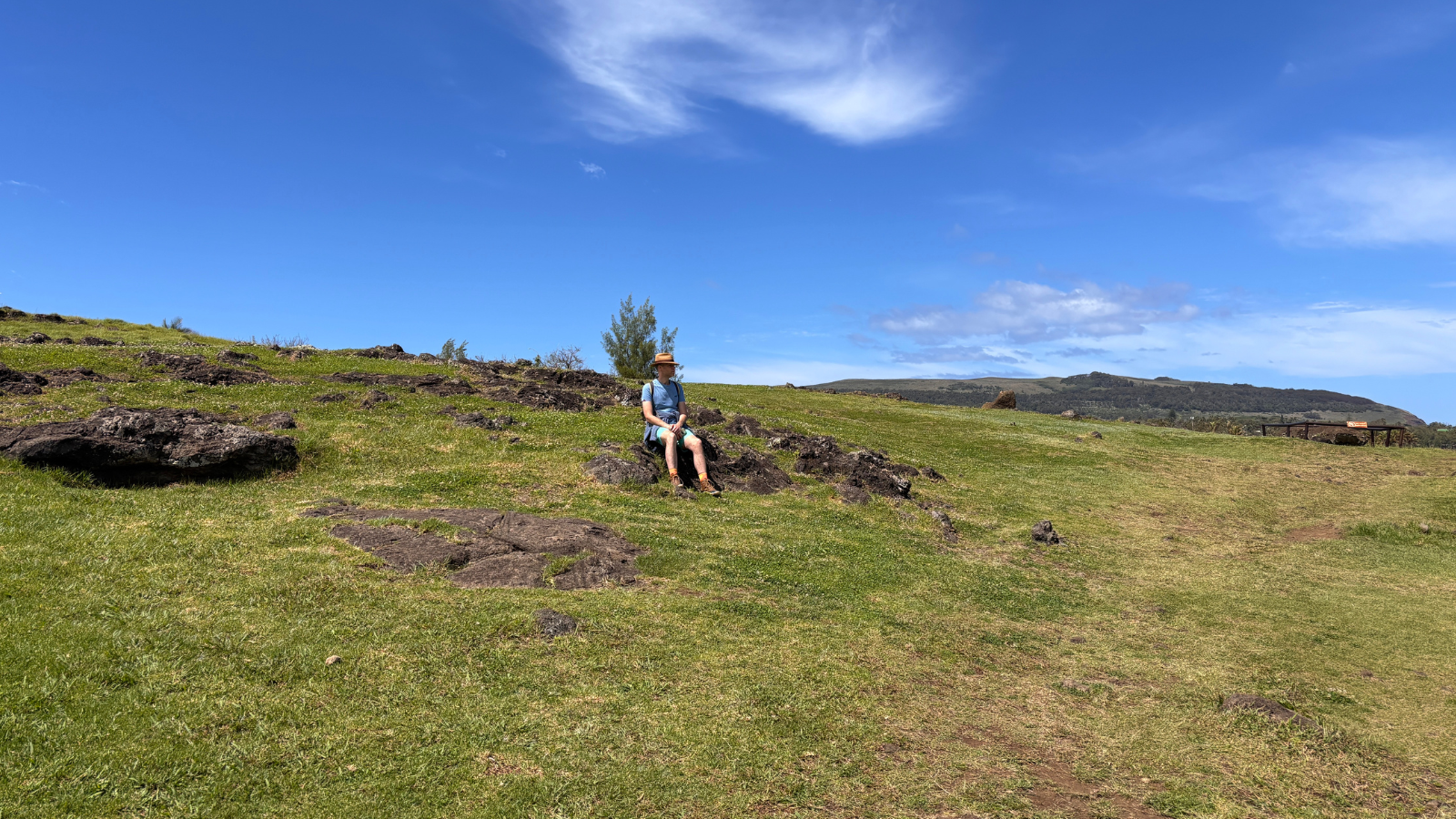
Almost everyone is familiar with the image of the large stone heads emerging from the ground—a sight that sparks curiosity about what might lie beneath the surface. For both Arjan and me, this has been a long-standing fascination; when we imagined taking a trip around the world, this destination quickly made it onto our list. And now, here we are—on that very island!
Our accommodation on Rapa Nui is located on the outskirts of Hanga Roa, the main town, about a half-hour walk from the harbor. On Sunday afternoon, we head down toward the harbor area. Unfortunately, we forgot our passports and our tickets for the Rapa Nui National Park, which means we can’t access any of the official sites—but the harbor area looks lovely, too. The sun is shining, the sea is calm, and the scenery is stunning. As we continue walking past the harbor, we suddenly spot them!
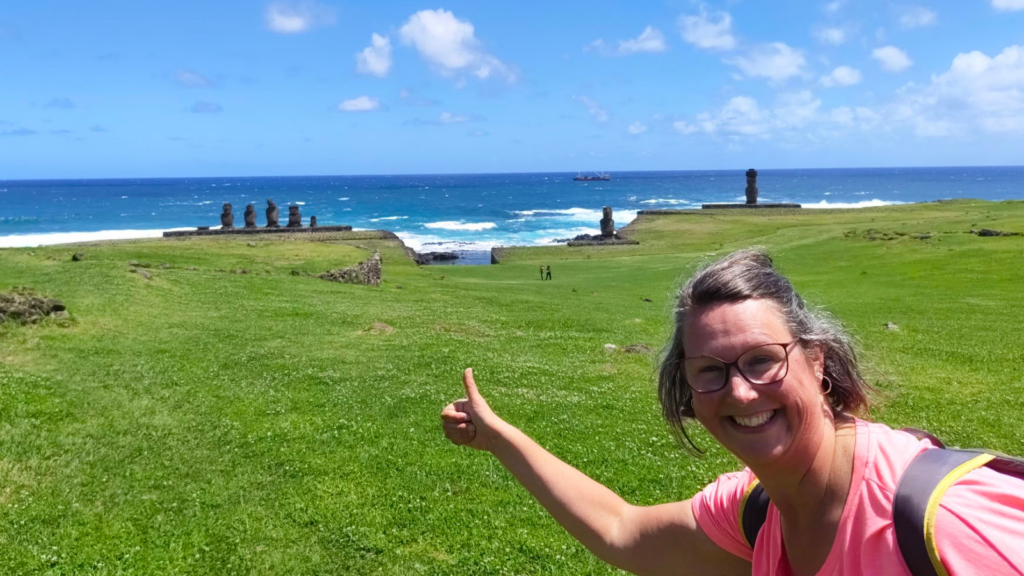
At Tahai, there is a row of six stone platforms, known as *Ahu* Five of these *Ahu* are topped with statues, or *Moai*—an iconic sight we’ve long been familiar with. We’re standing at Vai Uri! Arjan remarks that it feels surreal—as if he needs someone to pinch him to make sure it’s real. We’re walking across a hilly, green grassy field under a clear blue sky, with the five *Moai* standing with their backs to the sea. Breathtaking! We spend a long while just sitting and watching them, walking all around, and taking it all in. The *Moai* vary in size, and each one has a unique face. It feels truly magical.
But these statues are not the only ones. As we continue walking through the hilly landscape, we come across Ahu Tahai—a single Moai standing on its *Ahu* (platform)—which appears somewhat more weathered. The sun casts a beautiful light on its face, defining the shape of the nose and lips through the shadows. We completely forget to take photos here!
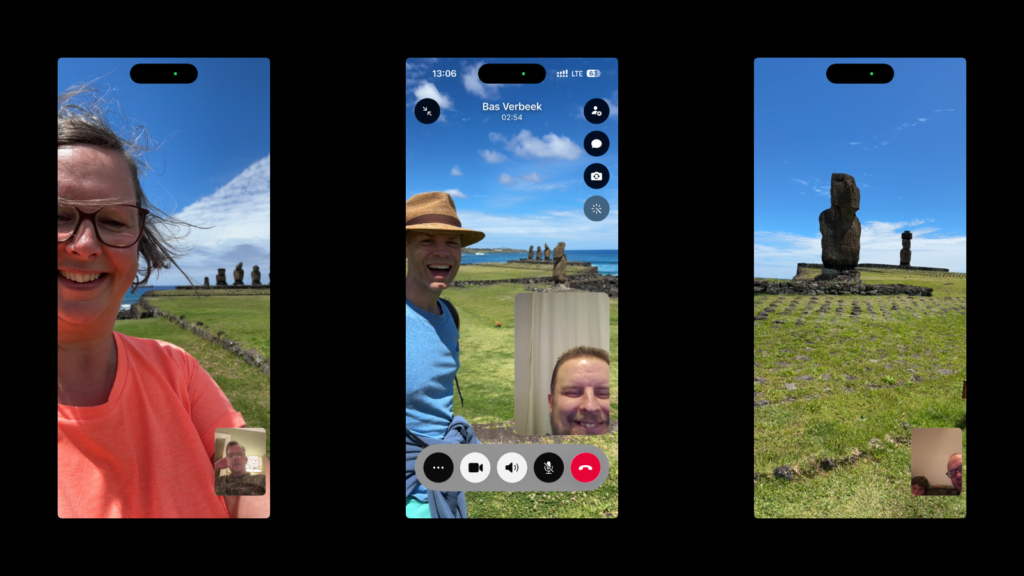
Looking to the right, we see perhaps the most famous statue of all: Ko Te Riku—the only Moai that still has its eyes! With its back turned to the sea, Ko Te Riku gazes toward us. It wears a *Pukao* on its head—a topknot-style hairstyle carved from red volcanic rock, sometimes decorated with petroglyphs. It creates an entirely different impression compared to the other Moai. For starters, it stands over 7 meters tall. Then there are the eyebrows, which are shaped quite differently, making the eyes appear much larger—eyes formed from white coral and black obsidian. The entire site is known as Tahai, and there are only six people around—two of whom are us. The experience feels incredibly surreal, and because it leaves such a deep impression on us, we decide to check if any friends back home are available. After all, what could be better than sharing such an extraordinary corner of the world with others? It’s morning for us, while back in the Netherlands it’s Sunday evening; we manage to connect with Jeroen, Bas, Willem, and Wim. Later that week, we also have video calls with Lieke, Manon, and Miranda & Jeroen. It’s absolutely fantastic!
All the Moai have undergone restoration, often as part of projects led by international teams. The Moai, the *Ahu* (platforms), and the *Pukao* (topknots) are all authentic—they are not modern replicas. However, because they are carved from volcanic rock, which is porous and prone to erosion, the Moai eventually toppled over. When they were set upright again, cement was used to secure the pieces together. In the first photo below, you can clearly see this cement where the Moai meet the *Ahu*.
The very first Moai to be restored—at Ahu Ature Huki—is located at Anakena, the historic beach where King Hotu Matu’u is said to have first arrived on the island. This restoration was carried out by Thor Heyerdahl and a Norwegian expedition in 1956. The seven Moai at Ahu Akivi were restored between 1960 and 1961 by the American William Mulloy and the Chilean Gonzalo Figueroa. The site of Tahai, near the harbor, was restored by William Mulloy between 1968 and 1970. In 1970, he also assisted with the restoration of Orongo—a topic covered in more detail in our blog post about the *Tangata Manu* (Birdman) cult. The 15 Moai at Ahu Tongariki were restored between 1992 and 1996 with support from Japan and the Chilean archaeologist Claudio Cristino. Since 1995, Rapa Nui National Park has been a UNESCO World Heritage site, which means that restoration, renovation, and new construction are now strictly limited. While some people support this, the local guides we spoke to find it regrettable, as they believe there is a need for further research.

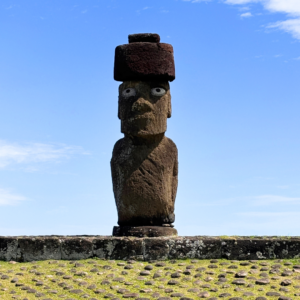
On the left is Ahu Ature Huki, the very first restored Moai. On the right is Ko Te Riku, the only Moai with eyes.
Rapa Nui National Park covers approximately 42% of the island, and you may only visit it when accompanied by a Rapa Nui guide. While some sites can be visited multiple times, many others are restricted to a single visit—such as Rano Raraku, the volcano where 95% of the Moai were created. Within and around the crater, you can find many Moai in various stages of construction; this is also the origin of the iconic image of Moai with only their heads visible above the ground. At Rano Raraku, we learn that the Moai were carved from a soft, yellow volcanic stone, though weathering has given all the statues a greyer appearance. A path is currently being constructed from the base of the volcano leading upward, which will allow visitors to view the crater. We imagine it must be an overwhelming experience to look into the very crater where all these Moai were once carved—it is still filled with them.

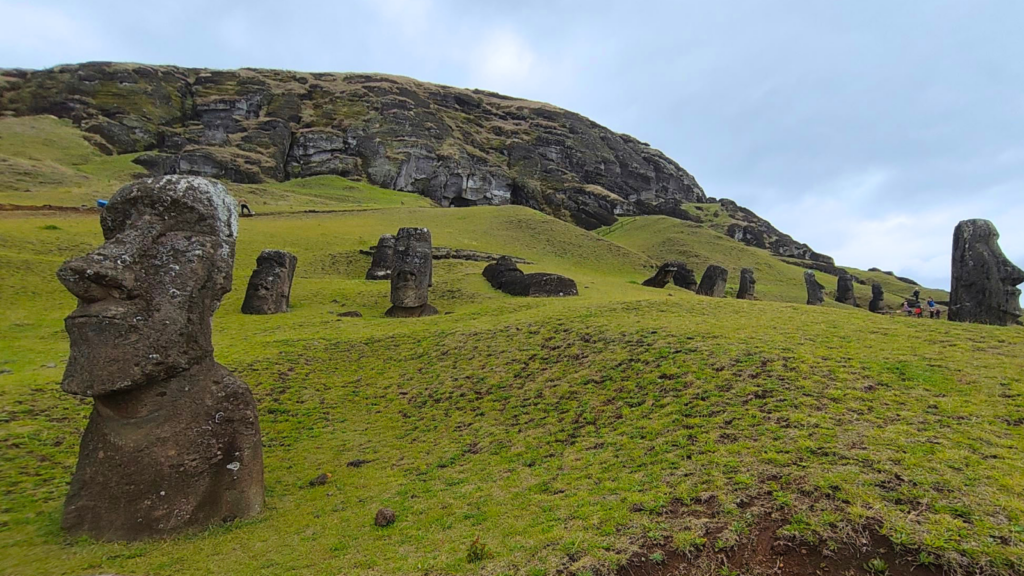
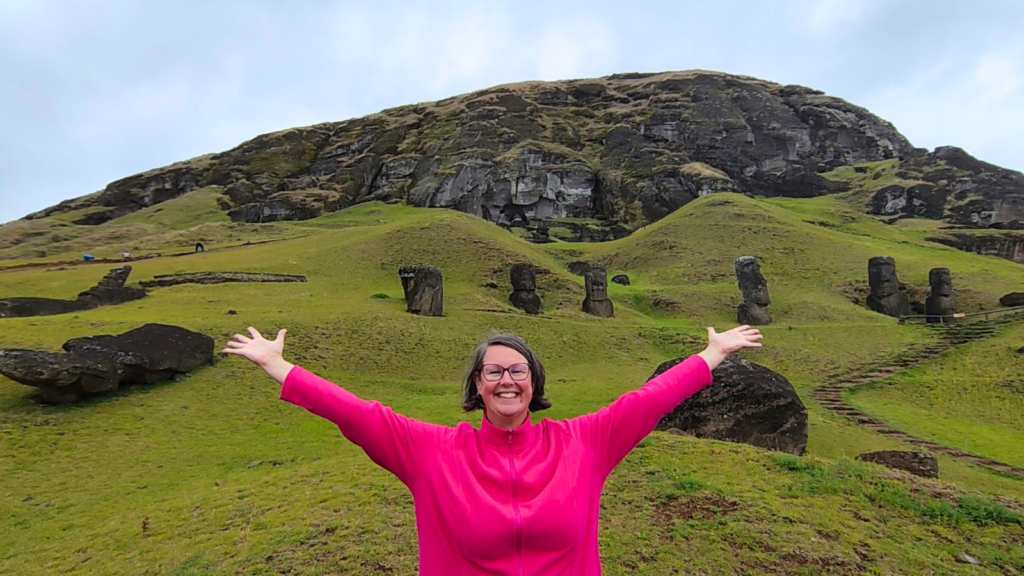
It’s wonderful to walk around here!
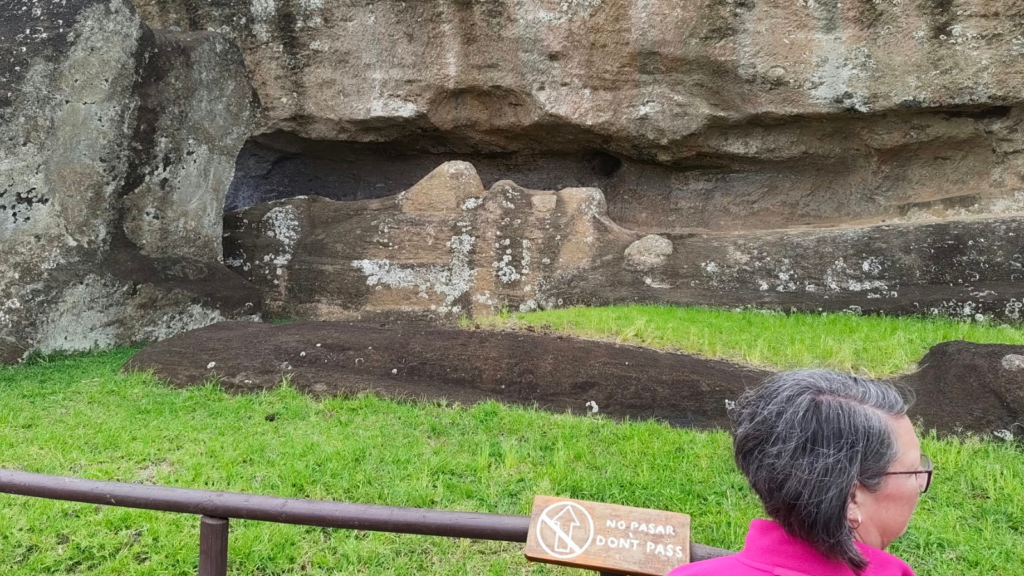
Throughout the site, you can see various stages in the carving of a Moai. It is shaped directly within the mountain, then detached along its back before being extracted from the rock face. Using an ingenious system, the Moai is tilted and freed from the mountain. As it is gradually brought into a more upright position, the back can be carved—until the Moai is finally ready to be transported to its ultimate destination.
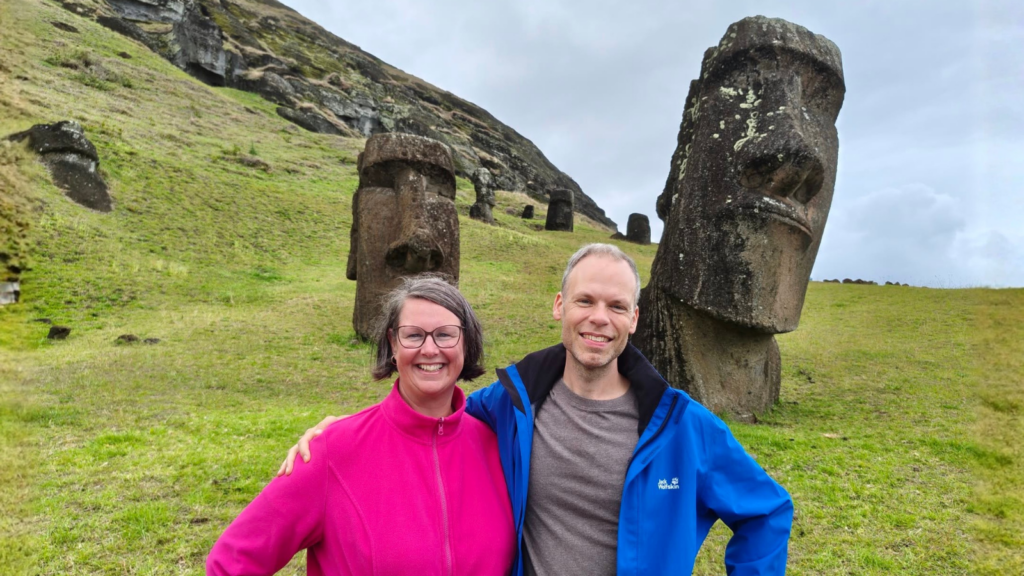
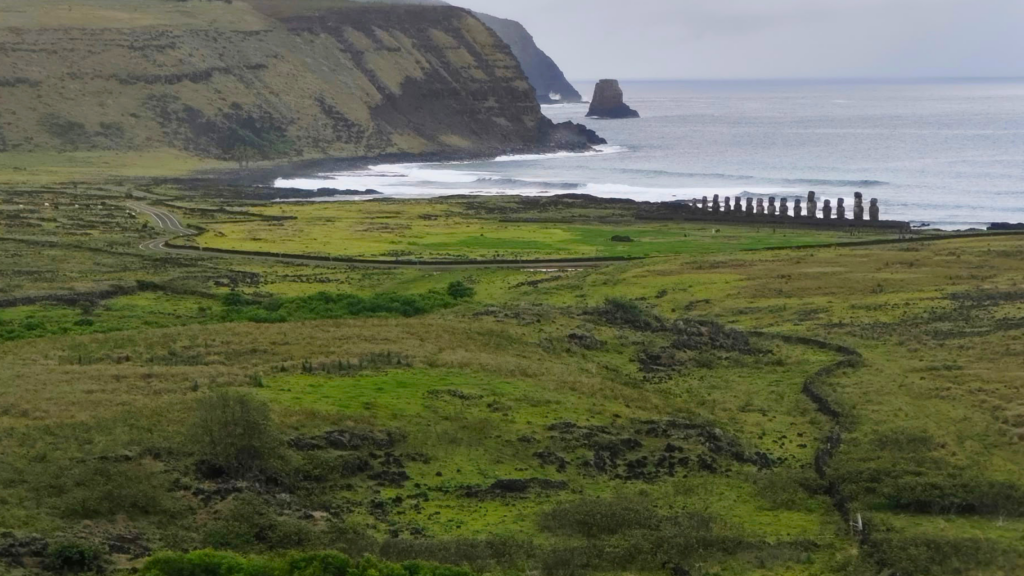
From Rano Raraku, you can look out toward Ahu Tongariki on the coast—a magnificent sight.
For tourists, opportunities to see the Moai or visit the Ahu sites are somewhat limited. The island’s key highlights are organized into various tours; we took three of them, which led us to some truly wonderful spots. If you ever travel to Rapa Nui, I highly recommend investing in a qualified guide—someone with formal training and deep, extensive knowledge (don’t hesitate to ask about this). Avoid the standard group tours, which tend to follow a rigid, impersonal routine: “Here’s stop number one—take your photos—back on the bus—off to stop number two,” and so on. Arjan and I aren’t fans of this approach; unfortunately, we ended up with a guide like that toward the end of our stay. Luckily, we had already visited those locations previously. A good guide completes the narrative and adds real depth. For us, the experience of being in a place—the feeling you get while standing there, the unique energy of each site—is far more important than capturing the perfect photograph. We take it all in.
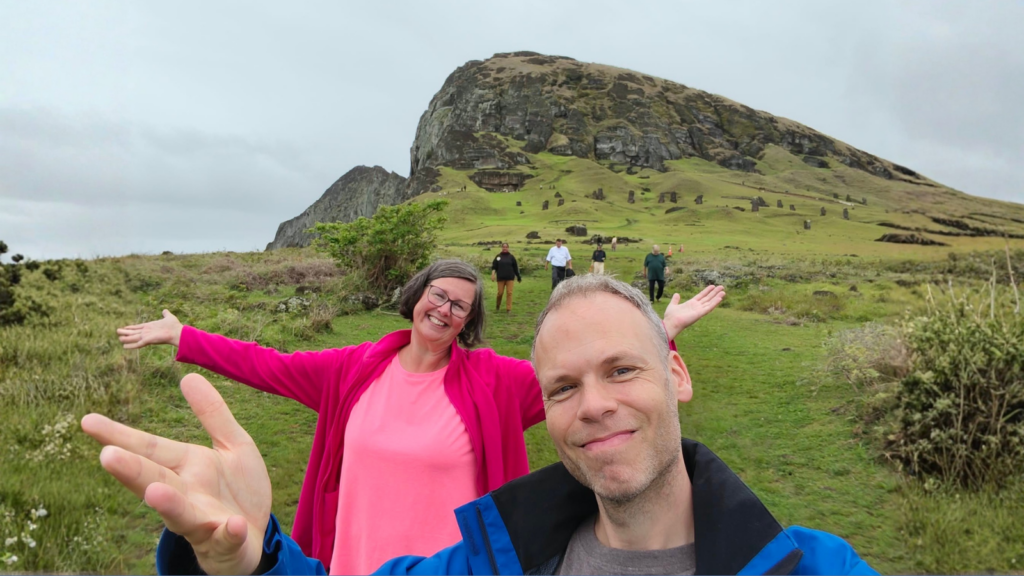
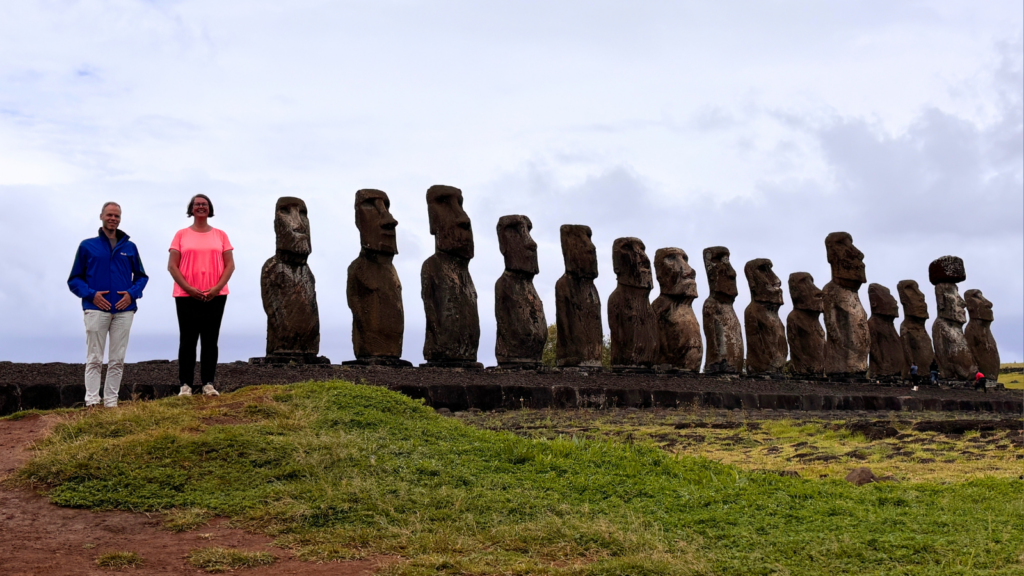
Our walk at Rano Raraku has, unfortunately, come to an end. We are only permitted to walk through here once. Next stop: Ahu Tongariki, where we can’t resist playing the part of tourists by striking the perfect poses. Arjan is there all by himself with 15 to 16 figures—which technically shouldn’t be the case, as an *Ahu* ought to have an odd number—so I step in to complete the scene, bringing the total to 17 figures.
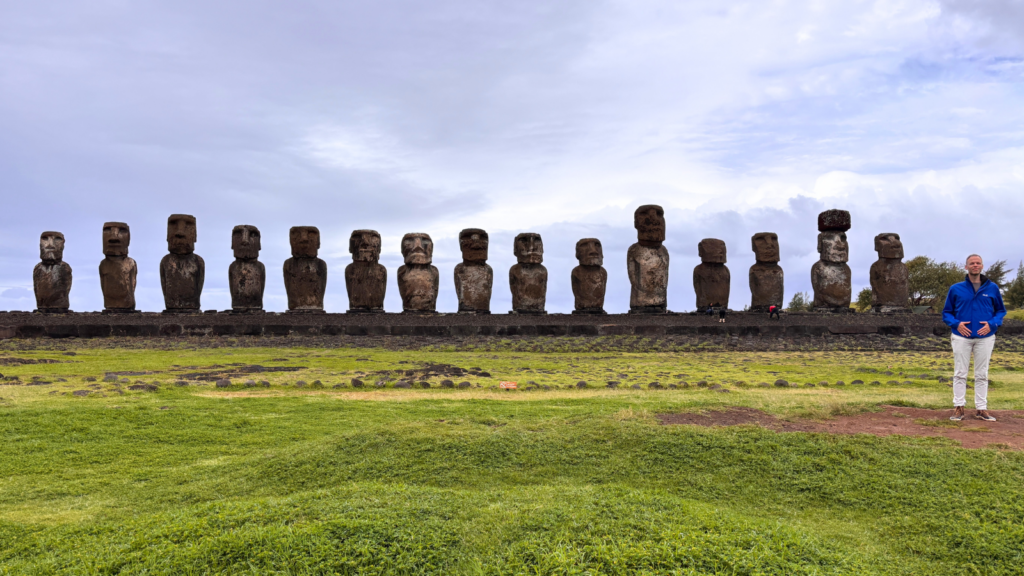
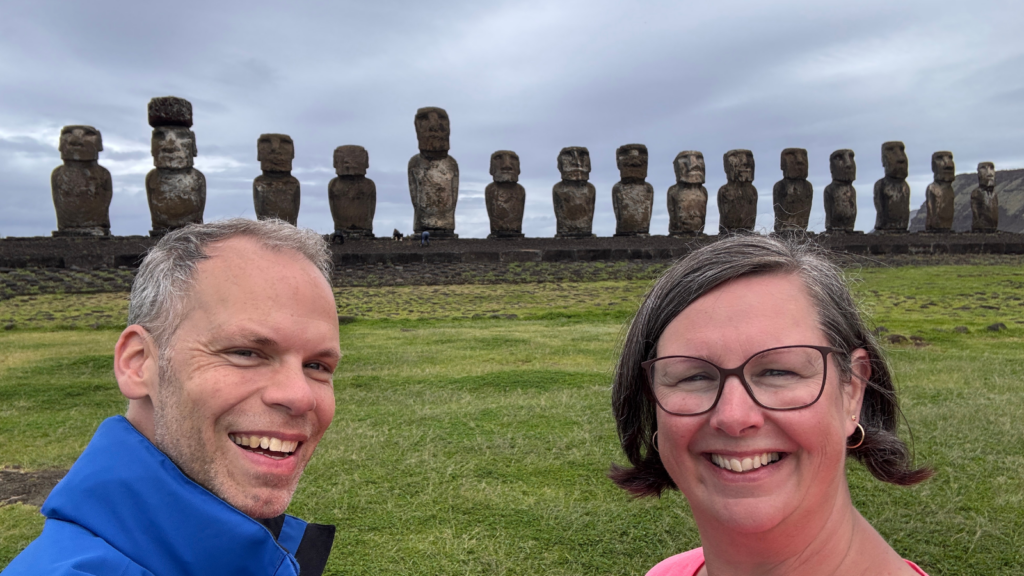
What is a Moai and why are they found everywhere on the island?
An Ahu is a sacred burial ground, where the remains of a person are laid to rest in the tribe’s grave after cremation. At each Ahu you will often find a cremation site made of volcanic rock at the front of the Ahu. The leader of the tribe is cremated here, later also the priest and subsequent leaders of the tribe. Other members of the family and tribe are cremated at the cremation site behind the Ahu. After which the bones are also placed in the Ahu. Only the most important people of the tribe, with strong Mana, receive a Moai. The Moai and the Mana strengthen the tribe. They stand inland, facing the tribe’s home. An Ahu with red volcanic rock is a royal family. There have been seven kings and over time many more other tribes.
We have learned about two methods of cremation. Initially, wood was used to heat volcanic rock, which in turn burned the skin and flesh away from the bones—the skull being the most significant part of the skeletal remains. There was also a period when wood was scarce on the island; during this time, the sun was used to decompose the flesh from the bones—a process that naturally took much longer. The sea would wash away the remaining skin, after which the bones were interred within an *Ahu*. Many *Ahu* feature multiple chambers and, often, subterranean levels. An *Ahu* serves as a tribal burial site—a structure found throughout Rapa Nui.
For the most prominent members of a tribe, a *Moai* was created. Once completed—often at the Rano Raraku quarry—the *Moai* was transported across the island to an *Ahu*. Upon arrival, a ceremony was held to place the *Moai* atop the *Ahu*. During this ritual, eyes—crafted from white coral, with irises made of red or black stone—were inserted. This created a portal for the spirit of the deceased. As we understand their culture, they did not believe in human-to-human reincarnation; rather, they believed that the spirit would transition into an animal—frequently a marine creature, such as a sea turtle. There is a profound connection between the Rapa Nui people and sea turtles. Following the ceremony, the eyes were removed from the *Moai* to allow the spirit to move on. In the past, there were specific occasions when the eyes were reinserted, serving as a way to greet the spirit once again.
After being set in place, some Moai are topped with a *Pukao*—a topknot made of red volcanic rock and decorated with petroglyphs. This red volcanic rock is even lighter and more porous than the yellow variety, making it easier to add after the statues were erected. There are both male and female Moai; all of them feature arms with hands that meet in front of the abdomen. On the male Moai, a phallic form is visible between the hands, while on the female Moai, a vulvar form can be seen. Because the volcanic rock is very soft and prone to erosion, many of the petroglyphs have faded significantly—a process that will only worsen over time. If you dream of visiting this extraordinary island, I wouldn’t wait too long—though you should perhaps wait just long enough for the path to the crater to be completed.
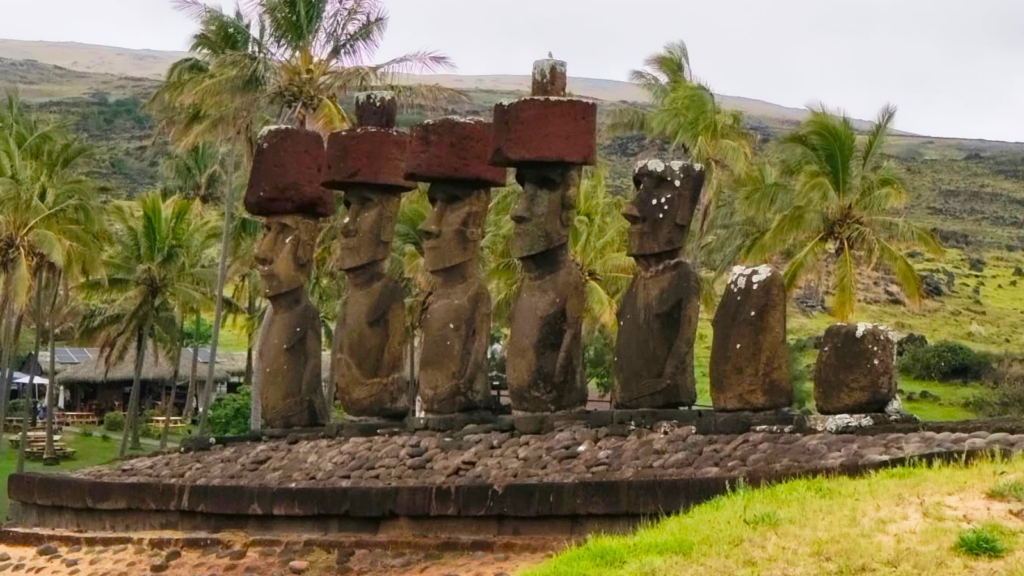
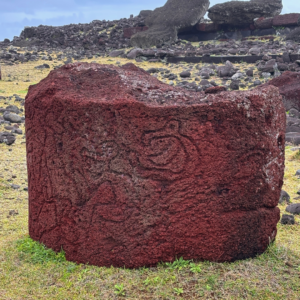
At Anakena stands Ahu Nau Nau, where you can clearly see the red Pukao. Below is a Pukao featuring visible rock carvings.


Special attention is given to Moai Tukuturi, which is unlike any of the others. It is a full-body figure—a person kneeling with their hands resting on their thighs. It stands near Rano Raraku, on the ‘back’ side, from where you can look out toward Ahu Tongariki. Our guide explained that the son of one of the master builders had passed away, and the father created this statue in his honor—an act that was not permitted at the time, as only tribal leaders possessing strong *mana* were entitled to have a Moai. The story goes that the statue remained hidden underground for a long time, but it is now on display.
The Moai were created between 1250 and 1500 AD. Following this period, a colder climatic phase set in, making it impossible to continue working the earth. Furthermore, there were no longer enough trees on the island to carry out cremations. Around 1600 AD, the *Tangata Manu*—or ‘Birdman’—cult emerged; more on that in our other blog post. We visited many *ahu* (ceremonial platforms) and saw both well-known and lesser-known Moai. However, there is a 10-hour guided hike through Rapa Nui National Park that we would have loved to take, as it would have allowed us to see other *ahu*—structures featuring stonework that resembles the walls built by the Inca. We do not yet know what the connection might be between these *ahu* and the Inca. Is there a connection at all? And if so, who developed the technique first? We remain curious.
It’s impossible to list every single Moai here and include all their stories—or all the best photos, for that matter. The fact that we were actually there, walking among them and standing right up close, is just incredible! So, we’re sharing plenty of pictures that include us in the frame. If you have a question about a specific Moai, just let us know—we’d be happy to share the story behind it, exactly as we heard it.
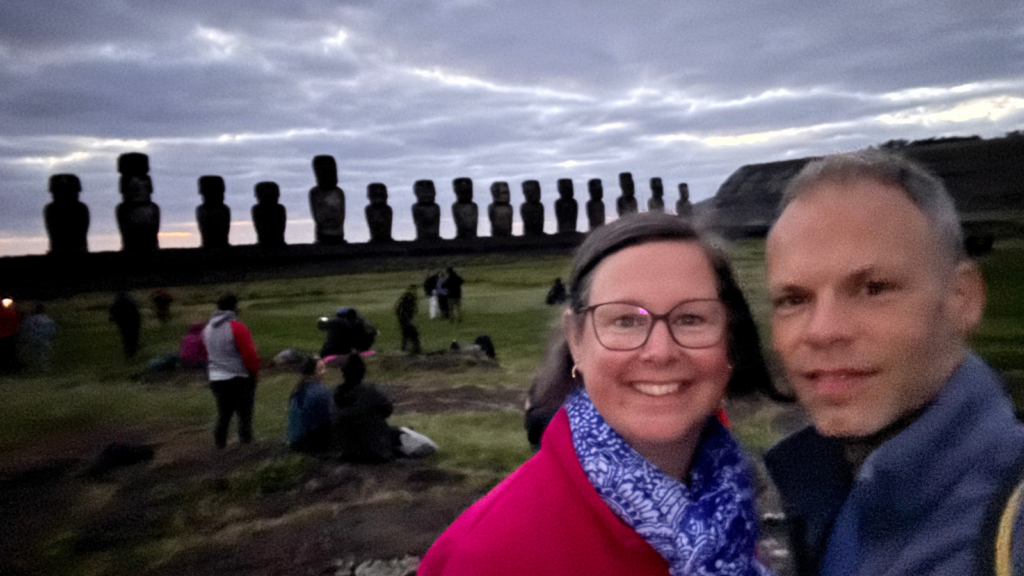
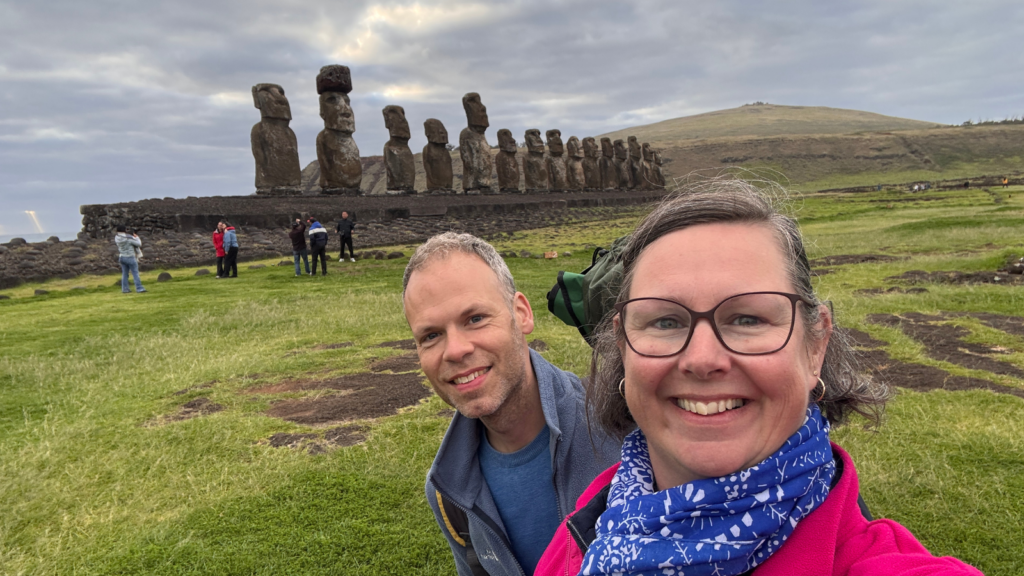


On our final morning, we return to Ahu Tongariki for the sunrise. Unfortunately, it is heavily overcast, and we don’t get to see any beautiful colors appear over the site. A few hours later, the clouds have cleared, and it is time to say goodbye to Rapa Nui. We depart for Santiago with full hearts.
Reply