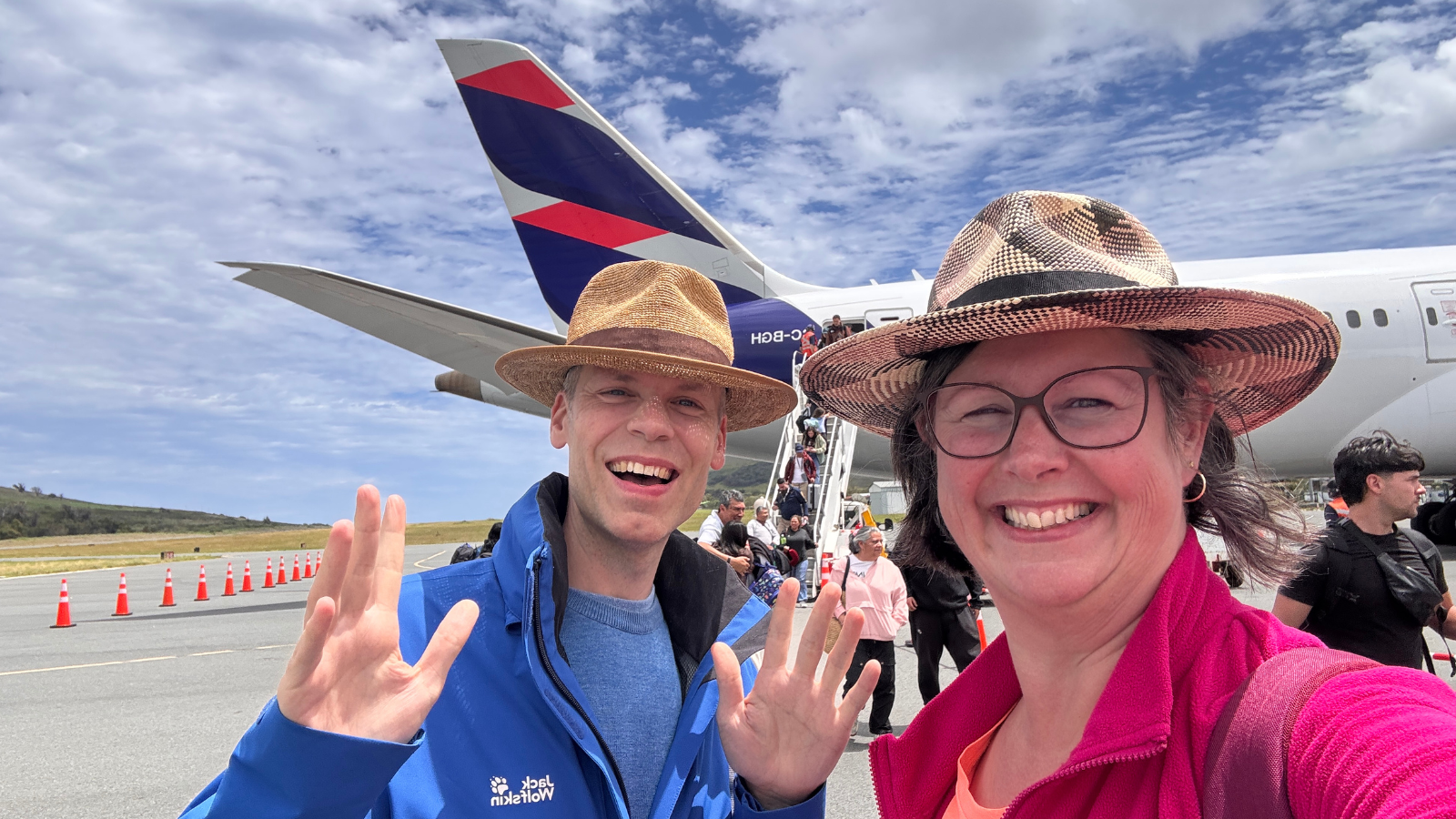
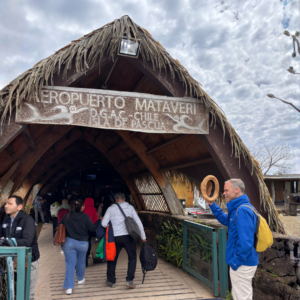
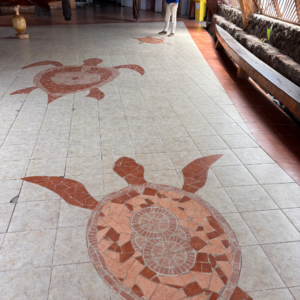
What a delight to arrive on Rapa Nui after a 6-hour flight. You are greeted by the sun, a pleasant temperature, and the sound of live music playing in the distance. We step off the plane via a mobile staircase onto the tarmac, then walk toward the arrival hall—a beautiful space featuring elegant arches on the ceiling and images of sea turtles embedded in the floor. Rapa Nui—we’ve arrived!
We are absorbing all the stories from the island, learning a great deal in just a few days, and remain curious to discover even more. At one point, a guide mentioned a connection to the Netherlands—naturally, we had to find out more. The island is called Rapa Nui, but most people know it as ‘Paaseiland.’ And as it turns out, that name is quite accurate! On Easter Sunday, April 5, 1722, the Dutch explorer Jacob Roggeveen arrived on Rapa Nui. While he didn’t ‘discover’ the island, he was the first European to document it, naming it “Paasch-Eyland” (Easter Island)—a name that has stuck to this day. Did you ever imagine such a connection? We certainly didn’t!
Given the rich history of Rapa Nui, I’ve noted down a few key facts. Before 1722, the island was governed by the Rapa Nui people. Their society was organized into leaders and clans, which can still be identified through family names. There is a book, “Te Mau Hatu ‘o Rapa Nui“, which contains the genealogy of 36 Rapa Nui families and can be viewed at the island’s library. Unfortunately, the library was closed for a Chilean public holiday when we arrived at its doors. It’s truly remarkable to be able to look so far back into the island’s history through these names. If you ever happen to visit, I think checking it out would be an incredible experience!

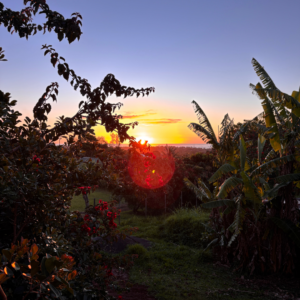
From our veranda, we witness a stunning sunset on our first evening, watching the sun sink into the sea.
In 1770, Spain claimed the island. In 1888, Chile annexed it, granting the inhabitants Chilean citizenship and civil rights. Rapa Nui feels a primary connection to the Polynesian islands within the triangle formed by Tahiti and Hawaii. Ma’u Henua—the indigenous Rapa Nui community—has managed the national park since 2018. As of 2023, the revenue generated by the national park goes to the Rapa Nui people. There are approximately 9,000 inhabitants on Rapa Nui: 3,450 are of Rapa Nui descent, while the remaining 5,550 are classified as “residents”—a group that includes Chileans, Colombians, Venezuelans, and Uruguayans.
Between 1860 and 1870, the Spanish took many Rapa Nui people to the mainland in Peru to serve as slaves. While those with specialized knowledge—both men and women—were taken away, the frail, the elderly, and small children were left behind on the island. When the enslaved individuals were eventually freed and returned home, they brought various diseases with them, triggering epidemics on the island. This led to even more deaths. According to local accounts, only 111 or 112 Rapa Nui people ultimately survived.
In 1864, the French missionary Eugène Eyraud arrived on the island. He brought the Catholic faith with him, and in 1866, missionaries established a permanent mission. The population of Rapa Nui is now largely Catholic. The arrival of the missionary brought about a shift in religious belief.
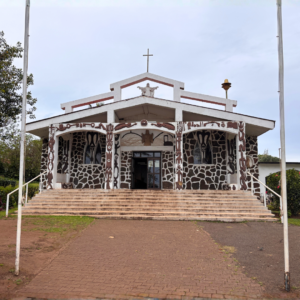
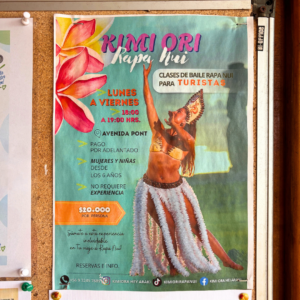
The Catholic church is richly decorated on the outside. When we walk by on a Sunday, it is completely full. Traditional dances are also frequently performed across the island.
Between 1895 and 1953, a private enterprise gained significant influence on the island through sheep farming. The sheep grazed the entire island bare, despite the fact that plants had been brought in. At that time, the Rapa Nui population was confined to the island’s only town, Hanga Roa—which remains the only town to this day.
We are struck by the fact that so many different people have come ashore here, some staying for as little as two hours before setting sail again; James Cook, for instance, did exactly that. For many, this small, volcanic island held little interest. Ironically, the accounts of all those aforementioned visitors are not particularly interesting to us, either—because the narrative we bring with us to the island centers on the journey of the seven travelers. How and where does that fit into history? We soon find out.
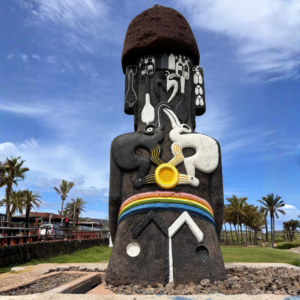
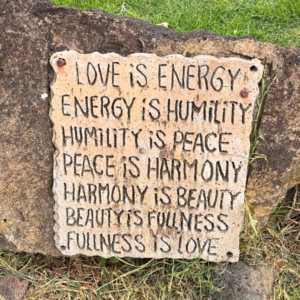
Near the harbor we come across some wonderful art projects.
Around 800 AD, a Polynesian group of seven travelers arrived on the shores of Rapa Nui. These seven explorers had been sent out by their king, Hotu Matu’u, to search for new land—a necessity, as their current island, ‘Hiva,’ was destined to disappear. The group consisted of a man, his sister, and five of his cousins. Remarkably, genetic and linguistic research has revealed that this population’s origins can be traced back to Taiwan and parts of Southeast Asia. We never would have guessed this, and it’s absolutely fascinating to learn! It immediately sparks our curiosity about those regions in Southeast Asia—could the legend of the seven travelers be known there, too?
Upon landing on Rapa Nui, the seven explorers realized the island could serve as a new homeland. They brought this news back to Hiva and King Hotu Matu’u. However, the return voyage was made by only six people; one of the cousins had perished in an accident involving a sea turtle. Following their return to Hiva, a large-scale migration to Rapa Nui took place. This means that the first people to reach Rapa Nui did not come directly from a mainland; rather, the island’s original inhabitants arrived from another island! What an extraordinary story.
Hotu Matu’a arrived on land at Anakena. A single Moai stands here, commemorating the moment the king first set foot on the island; it is the only “stout” (thick-set) Moai on the island. Anakena is also home to seven other Moai, which mark sacred burial grounds—a topic I explore further in my blog post about the Moai.
The king’s eldest son, Tu’u Maheke, established a settlement at Akahanga. During that period, the island was divided among seven tribes. These seven royal tribes eventually became the most powerful on the island, possessing the greatest amount of *Mana* (energy and power, both physical and spiritual). Even today, one can determine who descends from these seven royal tribes by looking at their surnames. At one point, there were 12 tribes, and by the era of the *Tangata Manu*—the “Birdman” competition—there were 18. The book “Te Mau Hatu ‘o Rapa Nui” lists 36 Rapa Nui families, reflecting a history in which many ancestral lineages have become intertwined.
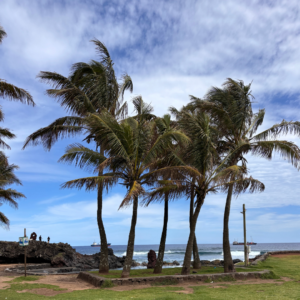
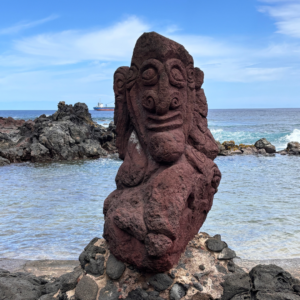
Even more magnificent art.
It is believed that Hotu Matu’a, the first king, is buried at Akahanga—though his remains have yet to be discovered. Within the settlement lies a significant sacred site, thought to be the resting place of Hotu Matu’a’s bones. There is a strong desire to investigate this, but conducting such research is challenging for several reasons. First, there is the perspective of the Rapa Nui people themselves; certain areas of the land are considered sacred. Due to a history of intense conflict, some locations are perceived by specific tribes as harboring “bad mana”—though which places carry this negative energy varies from tribe to tribe. The contemporary Rapa Nui population is understandably cautious regarding this. A second reason is that their history has been passed down primarily through oral traditions—stories and songs—many of which have been lost over time. Furthermore, each tribe may offer its own unique interpretation of a given story, which can differ from the accounts held by other tribes. A third factor is that the national park was designated a UNESCO World Heritage site in 1995, which imposes restrictions on research, renovations, and new construction. And finally, there is the fourth reason: funding.
We spoke with several guides who are actively engaged in research—both to document the oral histories of their own tribes and to work toward a unified, collective narrative. I find it fascinating that an ancient culture remains so vibrant and alive, while simultaneously encompassing such a diverse array of stories. It is wonderful to witness this dynamic nature, and I fully understand their desire for further research—such as DNA analysis or the use of LIDAR (a form of radar technology) to peer beneath the ground.
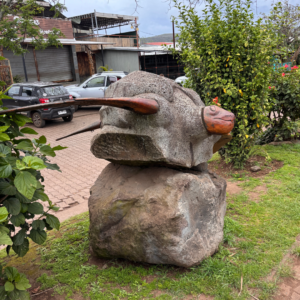
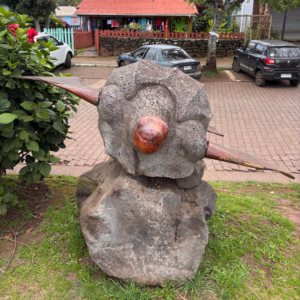
The spiritual connection to the sea turtle is reflected throughout the island’s art.
Rapa Nui, located in the Pacific Ocean, measures 12 kilometers in width by 24 kilometers in length—it is, therefore, quite small. “Mana”—a spiritual force—holds great significance on the island, as does the spiritual realm; one can truly sense a powerful energy there. We encounter magnetic stones: in some spots, you feel a sense of well-being, while in others, you experience a physical pressure, such as a weight upon your head. A large portion of the national park is off-limits to tourists like us. There are many sacred sites, burial grounds, and locations imbued with negative energy—what is referred to as “bad mana”—scattered across the island. One of our guides, due to her tribal background, cannot approach certain parts of the island, as doing so would expose her to the negative energy associated with a different tribe. Our hostess, who belongs to a different tribe, experiences the same phenomenon, though in entirely different locations. I find it fascinating that such a small piece of land can harbor so many distinct, potent energies. How much hatred and resentment must have existed here in the past? How many curses were cast? Evidence of cannibalism has also been discovered. Just how intense was all of this? One of our guides is deeply curious about these matters and hopes to uncover more through further research.
How do we experience the island? Rapa Nui belongs to Chile, yet it feels like an ‘Aloha island’ and shares a much deeper connection with Polynesia—of which it is, in fact, a part. The people are laid-back, and life moves at a tranquil pace. Animals roam freely all over the island; there is an overpopulation of cockroaches, chickens, and dogs, alongside large herds of horses and cows. While these horses and cows do have owners, the abundance of vegetation allows them to wander at will. Consequently, driving requires a gentle touch, and it is quite common to have to steer around a cow, horse, or dog. An interesting detail: whenever horses wander onto a property to graze, the dogs go wild, barking and chasing them away—often joined by neighborhood dogs, who form a pack to drive the animals off. While the livestock are free to roam on the roads and verges, they are not permitted on private property or in gardens. The locals don’t intervene, as the dogs handle it themselves. The dogs here are well-muscled, and we sometimes see them running at high speed for long stretches alongside motorbikes or cars.
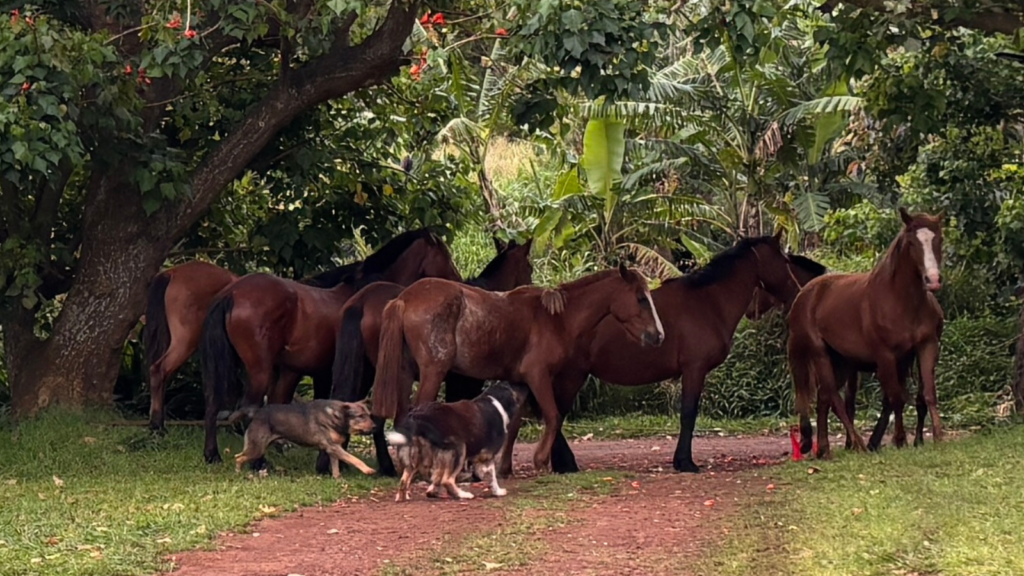
A large herd of horses is being chased off our property by the dogs.
To add a bit more about the physical island itself: it is volcanic, with three volcanoes—all of them inactive. We understand that sheep farming, in particular, proved catastrophic for the island’s vegetation, to the point where almost everything now appears to have been imported. The grass comes from Chile, the papayas from Peru, and the avocados from elsewhere. The island’s vegetation is essentially a collection of imported species. One of our guides mentioned that research is being conducted on this—not only here, but also on other Polynesian islands like Tahiti and in parts of mainland Chile—to identify native plants and bring them back to the island. We’ve seen some of this reforestation work; it’s wonderful to witness!
There is a significant distinction among the inhabitants of Rapa Nui. We’ve observed what could be called “positive discrimination” or a “Rapa Nui privilege.” Only the Rapa Nui people are permitted to work as guides within the national park—a role that comes with well-paid employment. Visitors, meanwhile, are only allowed to enter the national park when accompanied by a guide. Furthermore, only the Rapa Nui are permitted to purchase land or build homes. A clear example of this is our hostess: she owns a house and is married to a Chilean man, with whom she has a daughter. Should the hostess pass away, the house would not go to her husband, but rather to their daughter, as she carries Rapa Nui blood. Since 80% of the island’s economy is driven by tourism—with every visitor arriving to see the Moai—one can easily imagine the extent of the employment and income opportunities available to the Rapa Nui people. In our experience, it is a prosperous island. The islanders also enjoy certain advantages over the people living on the Chilean mainland. For example, if you need to go to the mainland—say, for a hospital visit—the waiting times are significantly shorter than they are for people who live on the mainland.
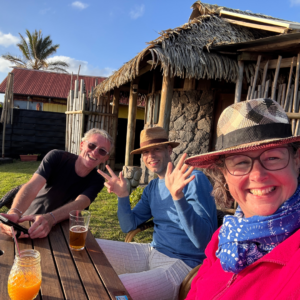
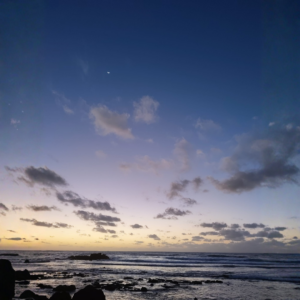
The evening of the dance performance happens to be our last night on the island, and we choose to watch the sunset—as it dips into the sea—alongside Gregory. It is absolutely stunning!
Visiting Rapa Nui was a long-held dream of ours. A six-hour flight across the ocean to a tiny speck on the globe—a place that has already seen so many visitors. Isn’t that extraordinary? And there is so much beauty to behold, so many wonderful stories to hear, and so many profound connections being forged between the past and the present. There is still so much left to discover. It has left us wanting more.
Reply