
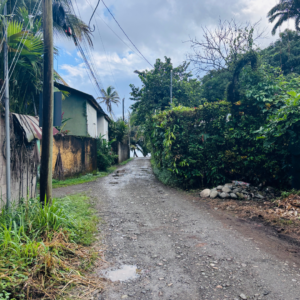
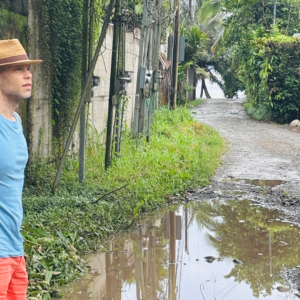
At Hotel Banana Azul, we rent 2 city bikes to take a trip from ‘Groenlo to Winterswijk’, 15 kilometers, to visit an animal rescue center. It rained heavily last night, and our road has large potholes and is filled with a lot of water. It is warm and extremely humid. But the view from the street looking directly out onto the sea is beautiful.

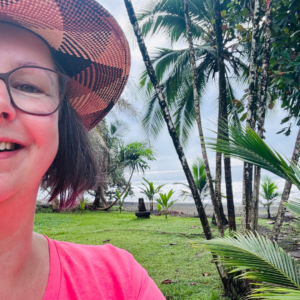
The beach here is black and is called Playa Negra, the black beach. A lot of lava grit from the volcano washes up onto the beach. Once you are in the village of Puerto Viejo, the beach changes color again, and a few kilometers further on, you have a ‘white’ beach. Great diversity in a small area.
We left early and the cycling goes fast, so we are happy to make a pit stop at the Caribbean Chocolate shop.

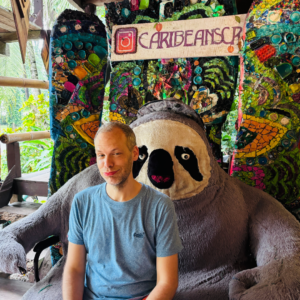
It’s only a little bit damp, look at Arjan’s back. And Arjan’s saddle is only a little bit leaky, look at Arjan’s pants. But luckily that doesn’t bother him, and he’s even capable of the Instagrammable photo with the Sloth couch.
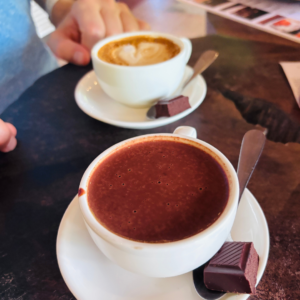
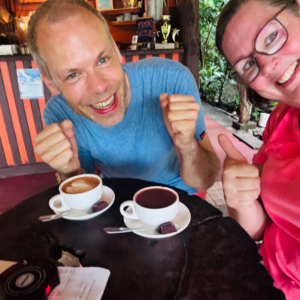
The chocolate to drink is super tasty. The first tasty chocolate we’ve tasted in this country. Look at Arjan’s happy face.
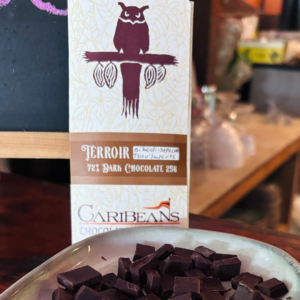
The shop also shows that they make ‘original chocolates,’ where it is noted which plantation the cocoa beans come from. In terms of quality, there is a huge difference compared to the chocolate from La Fortuna, Don Juan.
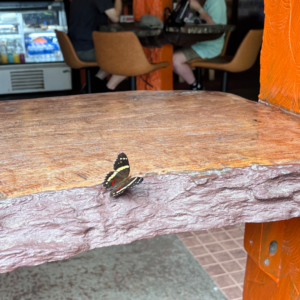
There are beautiful insects everywhere, and many restaurants and bars here have no walls, so you see small lizards every time, as well as beautiful butterflies.
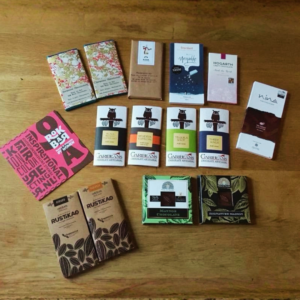
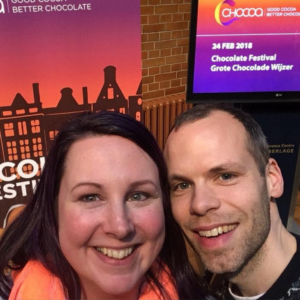
After I finished writing the blog and let Arjan read it, his radar started working. “I think we tasted this chocolate before, at the chocolate festival in 2018.” There were 3 cups on the counter in the shop from 2018… surely not… Oh yes, we tasted this chocolate back in 2018 and were impressed by it then too. (photos below from February 2018)
We cycle to the Jaguar Rescue Center. There was once a couple here, both veterinarians, who started this. They rescued a young ocelot, which people initially thought was a young jaguar. In popular parlance, it became known as jaguar. That name stuck, and when the place grew larger, they kept the name. Unfortunately for us, there are no big cats in the part of the center that is open to the public. They did not tell us whether there are big cats in the other part.
The center was set up to provide the local area with information and to rescue animals. Many wild animals end up here in accidents involving traffic or power lines. Animals that have been kept as pets, which is no longer permitted by law, come here. And wild animals, such as caimans and crocodiles, that have been in contact with humans, are not allowed back into the wild. This is a rule made by the government.

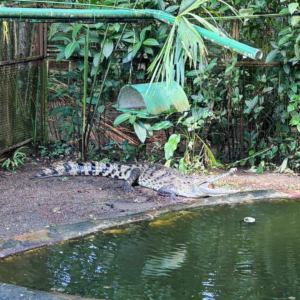
Caiman on the left, with turtles. Crocodile on the right, trying to cool down by opening its mouth. If this fails, it will sink into the water to cool off.
The grounds have a large hospital, and by July, 1,000 injured animals had already been brought in. Of these, 50% die from their injuries. Of the remaining 50%, approximately 80% return to the wild. They have a large piece of land where they work with various animals on reintegration into the wild. This is fenced off from visitors. During the tour, you hear a lot about it, but you don’t see any of it. Which I think is very healthy.
The birds here were raised as pets and cannot survive in the wild. Or they had an accident, for example involving their wings, and can never fly properly again. We see owls, small deer-like animals, toucans, red macaws, green macaws, and, what is nice, wild animals as well. When we cycled up, there were green macaws in the trees near the entrance. I’ll come back to that later. Congos were hopping back and forth in the treetops. Toucans fly overhead and small ground animals—I’ve forgotten the name—scurry around, for example near the macaws.


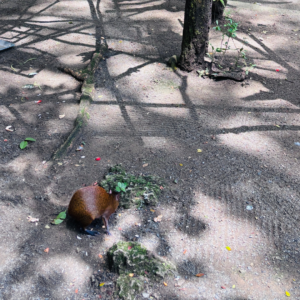
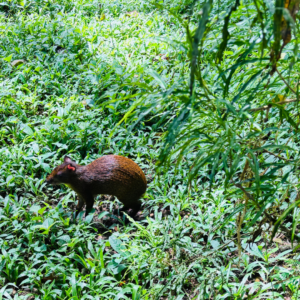
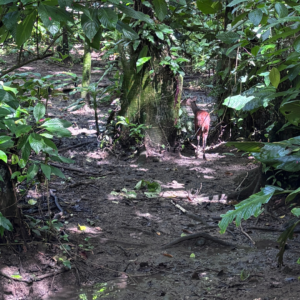
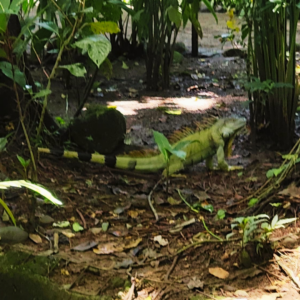
There are also iguanas in the trees feasting on the insects on the grounds. These are also wild animals. We quickly learn that everything high in the trees is part of the wild.
We saw a wild sloth in the trees. Later, we see sloths that are permanent residents on the premises. This is because they received electric shocks from the power grid and suffered severe burns as a result. Sometimes this even leads to limb amputation. Or they received a shock from the power lines and fell 7 meters, breaking something in the process, which means they can no longer climb properly in the wild. These are permanent residents at the center.
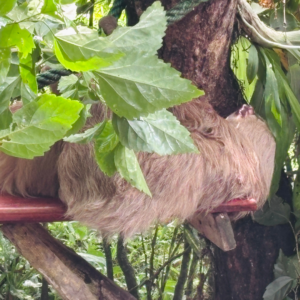
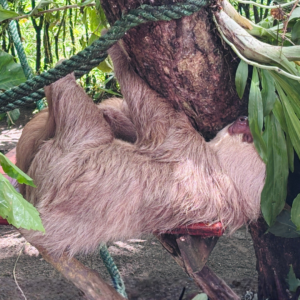
There are two types of sloths in Costa Rica. The two-toed sloth, which you can see here, is lighter in color and has a uniform face color. It has two toes at the front. All sloths have three toes at the back. And the other species is the three-toed sloth. These are somewhat grayer in color and have a mask on their face, like a panda. We saw one of those in La Fortuna, and that sloth high in the tree is also a three-toed sloth.
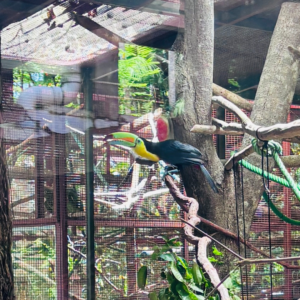
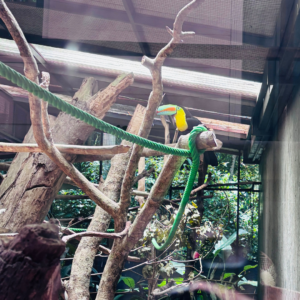
We have already seen toucans flying overhead a few times and seen them in the tree near our cottage, from a distance. Taking photos is not possible because every time it was against the sun. In the meantime, we have seen three species of toucans, and here is one below to show its beautiful colors.
After this visit, we are looking for some coolness and rest. It is extremely humid and stuffy because so much rain fell last night, and we both feel quite faint. We are soaking wet and looking for some relief. We cycle another 2 kilometers, which provides a lovely breeze, and end up at an open-air studio with a bar. Where, due to a power outage, we can only get coconut juices. But that is very tasty for replenishing fluids and electrolytes. We sit here for a while before moving on.
The visit to the Jaguar Rescue Center is at 9:30 AM. And another 4.5 kilometers of cycling further is the Ara project in Manzanillo. They have visiting hours from 3:00 PM to 4:00 PM. Once again, we get back on our bikes and end up at the next little restaurant. As the crow flies, it is 100 meters from the Ara project. It is nice to sit here and get some cooling. At one point, something falls from the trees, which we thought was just a falling leaf. The owner walks up to us and starts telling us. “Come look, there are Spider Monkeys in the trees here. They throw things down.” She takes us along a path and we see a beautiful pair walking and swinging from tree to tree. Much too high and too fast to take good photos. Spider monkeys don’t like people and are hard to spot in the wild. We are standing on her land and she is the neighbor of the Ara project. We hear interesting things about the area and get a bit of confirmation of what we already suspected.
There are a few peculiar things about Costa Rica:
- All the nature parks turn out to be private property. Even in Monteverde, there used to be mainly farmers, and at some point, space was created for nature again. It has not become clear to us whether this generated more money, or if life as a farmer was too hard at the time and it never really took off.
- There is a lot of advertising aimed at tourists regarding reforestation. Since 1980, the percentage of nature has gone from 40% to 60%. This was initiated by the government, by giving money to people to let pieces of land turn back into jungle. But the current status is unclear.
- Tourism is everywhere we go. And construction is happening everywhere. Roads are being added, many new houses are being built. Many new hotels are being added for the tourists. Every new construction project leaves less space for animals to cross.
- Electricity cables run exposed and exposed across the top of the road. Every year, thousands of animals are electrocuted, but there is no joint approach to cover the cabling with plastic or to bury it underground.
- There are private initiatives to create wildlife crossings, even though we have long been familiar with this in the Netherlands. There are also initiatives to cover exposed power lines. But there is no joint approach to this. What is the government’s position on this?
- The Ara project was started because green macaws were nearly extinct, partly due to the shrinking of their habitat. This is caused by the existence of massive banana and pineapple plantations. (On the way from La Fortuna to Puerto Viejo, we encountered 30 km long plantations.) The design of these plantations did not include a ‘jungle strip’ to allow the animals to continue connecting areas. How old are these Chiquita, Delmonte, and Dole plantations?
In short, a few things that bother Arjan and me from time to time. I am especially glad that various projects also provide education to children, so that they do not have to kill every snake that enters a house. The gap between rich and poor is also present here, because at the rescue center we also hear about poaching. This has been prohibited for years, but for some people, it is the food on the table. It raises questions for me.
Meanwhile, Arjan and I get back on our bikes to the Ara project. Increasing the group of green macaws is the goal of the project owner. They started this project in 2010. Green macaws reach sexual maturity at 7 to 8 years of age. They are monogamous and lay an average of 2-4 eggs at a time. They do not build a nest, but lay it in a hollow tree. As a result, many predators can easily take the eggs and chicks, such as toucans, spider monkeys, iguanas, and other animals. There are currently 11 pairs within the project that build their nests in the nest boxes the project has installed. There are 25 nest boxes hanging in the surrounding area. There are 4 pairs that have raised chicks in the jungle. They know this because all the macaws born in the nest boxes are ringed. The project has cameras installed in the jungle and sometimes sees birds without rings passing by. If there is a nest in the nest box, they monitor it for diseases, etc. As a result, they have lost only 3 chicks so far, and the population is growing steadily and well. In the beginning, they received all their food from the project. Now, all the birds get almost everything from the jungle. A nest box can be seen in the photo on the right below.


Every day, the green macaws are given some food: 5% of their needs in a bowl that they hoist into the air, which is why we encounter a number of macaws at this spot. After eating, they leave this place to fly to their overnight location.
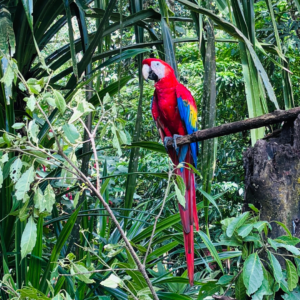
When a macaw is still and sitting on a branch, you see absolutely nothing. When it spreads its wings, the beautiful colors of blue and red emerge. The green macaws are considerably larger than the red macaws.
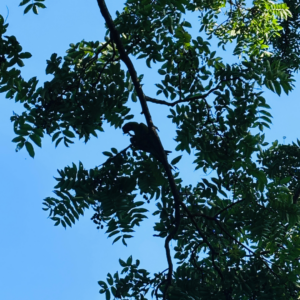
We are lucky that, during the guide’s explanation, a macaw comes and sits with us in the almond tree.
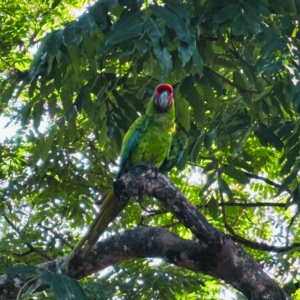
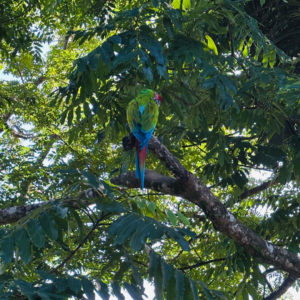
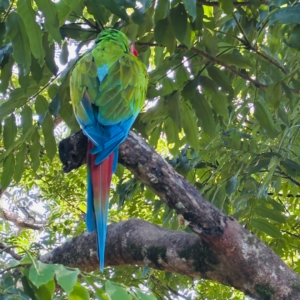
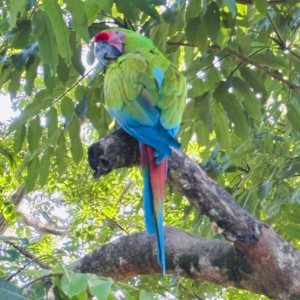
We are looking into a sort of valley, and when the macaws fly, it is a beautiful sight. Unfortunately, we didn’t manage to capture it in a photo. Besides macaws, we also see various toucans flying; some skim over our heads. Beautiful nature!
High above us, a macaw is nibbling on nuts the whole time, and a peculiar insect lands on Arjan’s shoe.

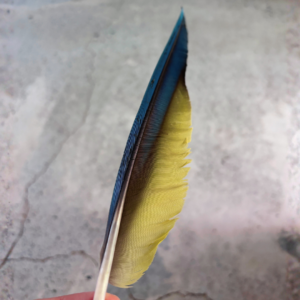
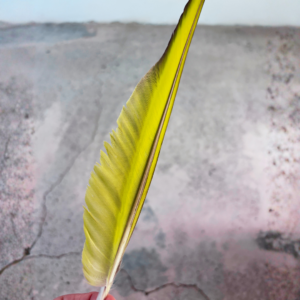
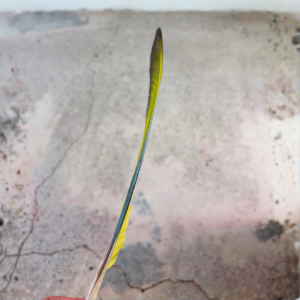
We are getting ready for the bike ride back home and have seen so many animals today. Absolutely amazing! Arjan has found the bonus of the day. As we walk away from the viewpoint at the Ara project, there is a feather lying on the ground. It is a feather from a macaw. Difficult to capture in a photo, which is what makes it so beautiful. But the feather has various colors if you turn it a little. Yellow, blue, green. You’ll just have to take my word for it.
Reply