
Naturally, we couldn’t let a night tour pass us by in Monteverde. For this, we chose the Curi-Cancha reserve night tour, due to the abundance of wildlife. The tour runs from 5:30 PM to 8:30 PM, as it gets dark between 5:00 PM and 6:00 PM.
In a small group of 7 people—3 couples and our guide Dauner—we enter the reserve. We are in the foothills of a subtropical storm that made landfall on the Caribbean coast, resulting in a stormy, rainy day for us. However, protected by the canopy of the ‘cloud forest,’ we do not expect much rain.
There is a difference between the cloud forest and the rainforest. The humidity in a cloud forest is many times higher, and there is less sun because you are literally in the clouds. The rainforest receives more hours of sunshine. Therefore, the vegetation and animals can be different.
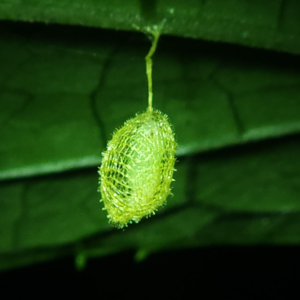
We are introduced to a small creature that makes a cocoon made of silk. Dauner shows it to us, hanging under a leaf. Sorry, neither of us remembers the little creature.
Unfortunately, we didn’t see many larger creatures. The two tarantulas in their burrows weren’t sitting at the entrance. They are home, though, but have dove deep into the burrow because, for example, they have just eaten or are in the process of molting. Secretly, I didn’t mind that, with my arachnophobia.
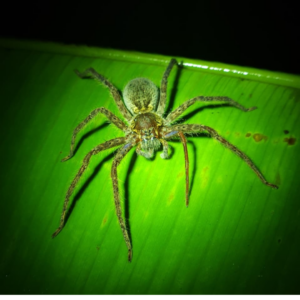
However, another spider was seen later on, with 8 heads directly on its body. It was a small one, about two-thirds the size of a palm. I walked on when the guide was giving an explanation so that I couldn’t see it. Arjan and the others looked at it up close. This spider is quite venomous, as it can easily kill a large tarantula with its venom, and therefore other smaller animals as well. Glad I walked on. 😉
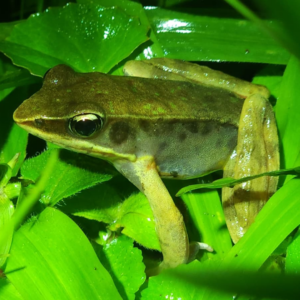
A few owls flew away right in front of us, and bats flew past us several times. By a lake, we saw one frog, which was yellow with red spots on the underside, but we only saw its beautiful camouflage on the top.
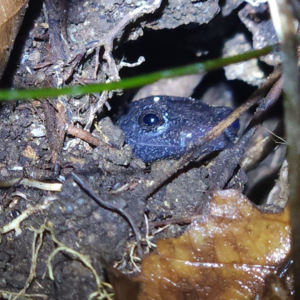
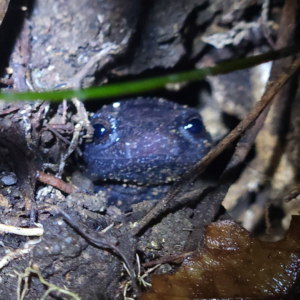
As we walk away from a small river, we see a small head with tiny beady eyes on the bank. A salamander. Bluish, it has no gills and breathes through its skin. It lives in a super-humid environment but never enters the water. The skin is fragile, and yet this little creature has remained as it is for hundreds of years.
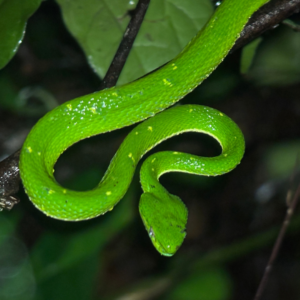
At the end of the walk, we see a viper—sorry, I forgot the species—a baby snake in front of us. It is sitting very low to the ground, while we keep looking up. The viper is hunting here. It is an intelligent little creature, because it sits on a path where animals pass by. And it has patience. Dauner told us that he had seen an adult viper in the same spot for three months, waiting for prey.

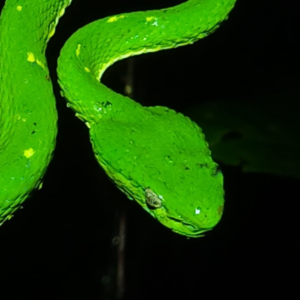
On the head of the viper, the ears are located at the front near the mouth. The eyes are small spheres with sensors between them that researchers say can detect heat and use it to hunt. In the photo below, it is the dark, larger shadow in front of its eyes.
We don’t see many animals on this walk, but we hear plenty. Wow… At one point, it was a deafening sound of insects going wild just before dark. A few minutes later, they went from full volume back to normal, and we hear a lot of birds. At least, that’s what we think. Dauner says they are frogs, which sound like birds. In the distance, there is a hissing sound… which he tells us are owls. Every now and then, a firefly flies by or we suddenly see something light up in the distance. It is super busy in the cloud forest, truly a cacophony of sounds.
Reply