Quilotoa is a volcano located higher up in the Andes Mountains. This volcano erupted about 800 years ago and lost its summit. The ground around the volcano is cracked, creating deep craters. When the summit was lost and the volcano cooled down, a lake formed. This lake has a diameter of 3 kilometers. It is known as Lake Azul; because of the presence of various substances such as sulfur and iron in the soil, the lake displays beautiful shades of blue. Today we are going to visit this volcano and stop by a number of other nice places beforehand.
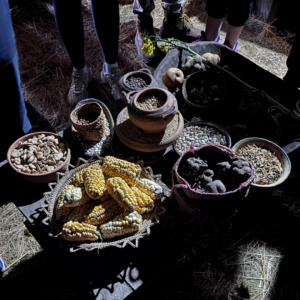
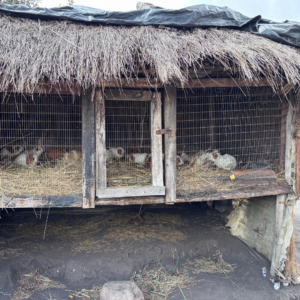
After a long drive, we start with a visit to a farmer in the Andes Mountains who has kept his old hut. He speaks a little Spanish, but mostly Quechua. And we are not the only tourist bus passing by. We are allowed to enter the hut and are handed all kinds of bowls containing beans and various types of potatoes. The farmer grows 24 varieties of potatoes, but the guide cannot answer why, or what the differences are in taste and use of the potatoes. Outside, they have various cages where guinea pigs are bred. These are for the market to sell. They eat guinea pigs, and in some regions, they use guinea pigs for a form of healing, where a guinea pig walks over a person, absorbs the disease, and is then killed.


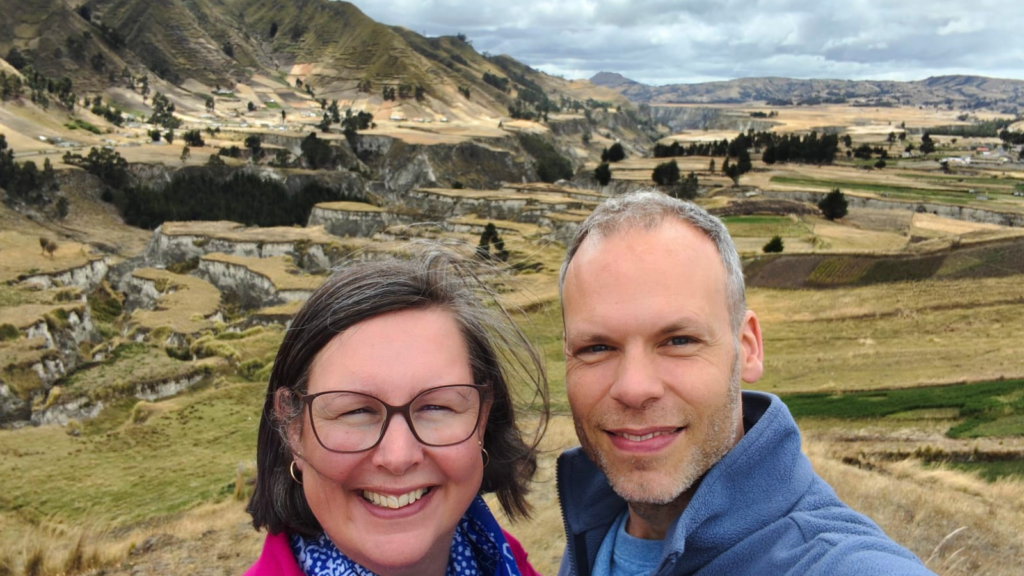
We only hear the guide’s stories, and they feel exaggerated. In the immediate vicinity, we see small farmhouses everywhere, and everything is made of stone. Except at this location, on the mountain where we are, there is still a round hut. The view is beautiful, and the type of people—different again from Quito and Otavalo—is lovely to meet. The traditional clothing is different again. They wear red blankets and ponchos instead of black cloths. They also have a deeper, darker skin tone. At an altitude of 4,000 meters, you are somewhat closer to the sun, and you can see that. The gentleman and lady in the photo are 80 and 75 years old. The way they move makes them look much younger.
What surprises me is that many people outside the major cities still speak Quechua. Besides Spanish, this is the largest language in the Andes Mountains and is also spoken in many surrounding countries. None of the guides we see, who have been working here for years, speak Quechua and keep calling it the language of the ‘indigenous people.’ If I worked here, I would have learned a little of the language.
Driving through the landscape, it is fun to see animals. Every now and then there are a few cows walking around, a pig, a few sheep, a llama or an alpaca, and here again, dogs everywhere. They walk in the meadow, they lie spread out on the road. Often together with a friend. Dogs have developed a special bond with the land. After a short stop at a local art workshop, we drive on to Quilotoa. The art workshop is actually even sadder than the visit to the old farmhouse. It is nice as a bathroom break, but everyone has seen enough after a few minutes. But fortunately, we are driving through a beautiful landscape. As mentioned above, the volcano erupted, causing it to lose its summit and deep craters to form in the immediate vicinity. What a breathtaking landscape the craters are. Truly beautiful!
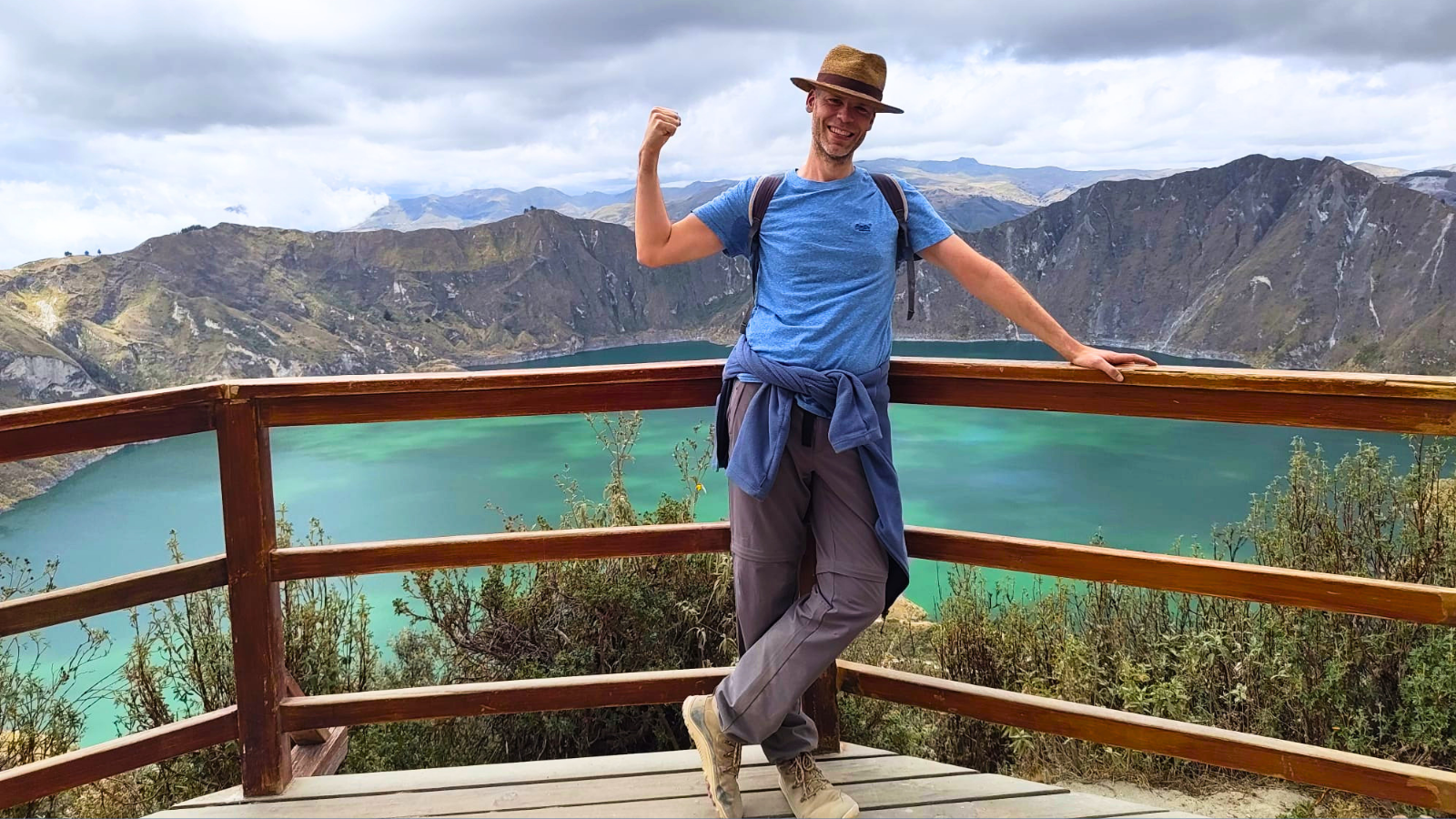
In the distance we see the volcano, and we have two hours to hike there. We start by bus at an altitude of 4,000 meters. We hike together to a viewpoint about 1.8 kilometers into the crater, and it is beautiful! There is a path leading down, which many people take. Arjan does too. I stay seated at the top, because I have had a bad cold for a week and my lungs feel weak.
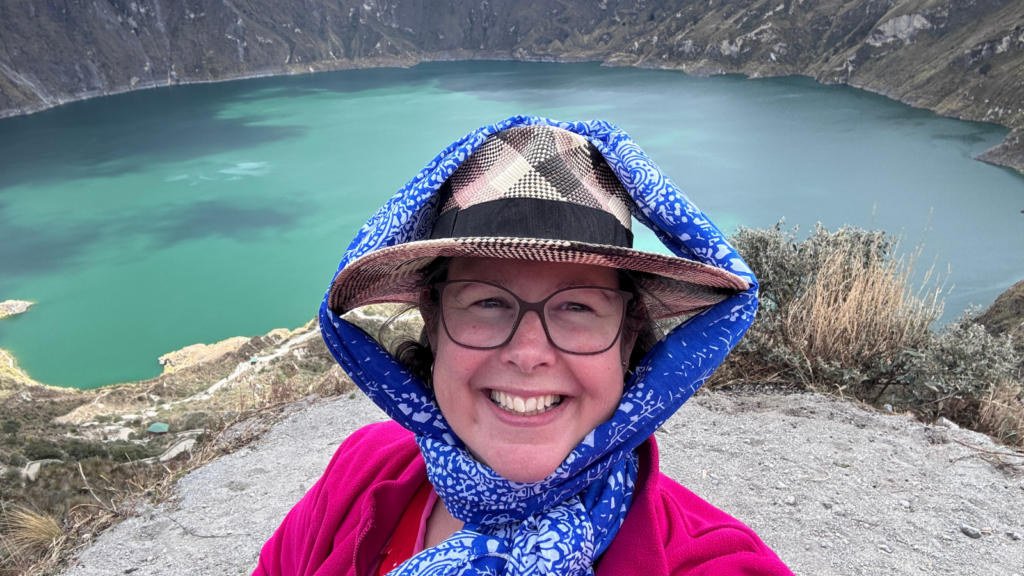
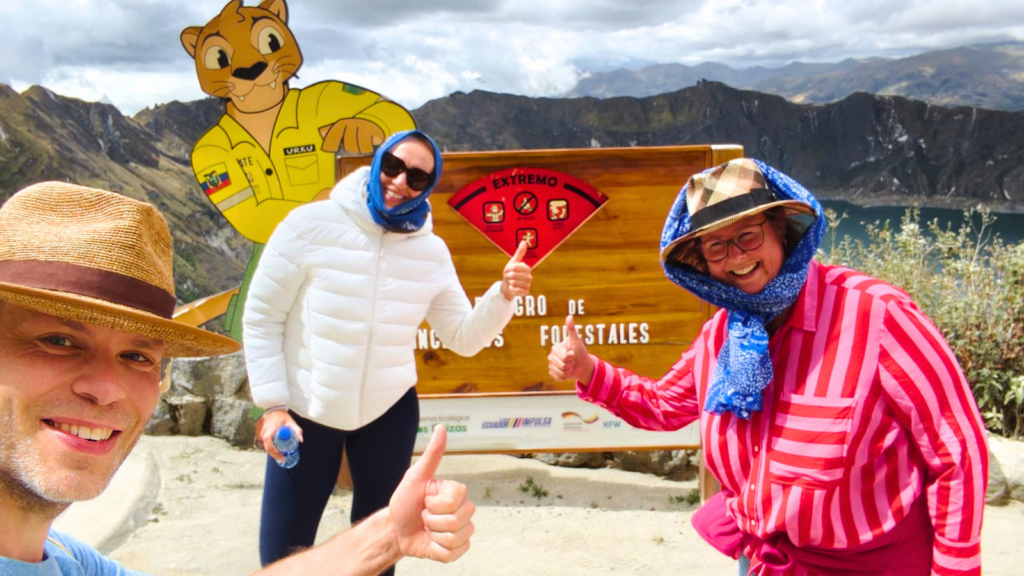
I sit down on a bench where Emily is already sitting, and we have a wonderful conversation for an hour. She is traveling indefinitely and has been on the road for three months already. Her next country is also Peru. We are going to stay in touch so that we might meet again at a future location. Meanwhile, I see people from our group walking back up, so I stay comfortably seated. The wind is blowing strongly and the sun is bright, so I’ll just ‘protect’ my hat with my scarf for a moment.
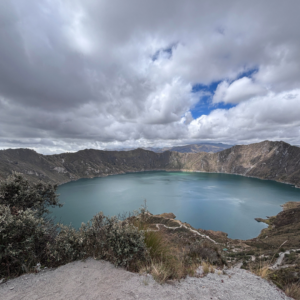
The crater lake changes color all the time. When clouds hang over it, it takes on a different shade of blue. It is beautiful to see.
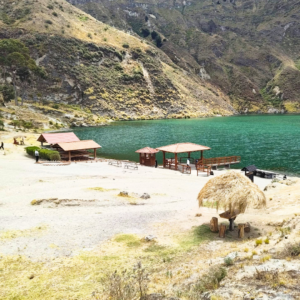
Arjan walks down and that goes fine. You descend 400 meters to the edge of the water.
But then the road goes back up.
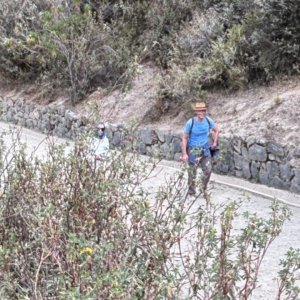
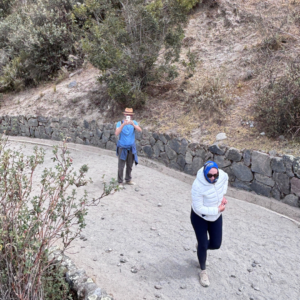
The guide explained clearly that walking down is fine, but the way back up from 3,600 meters to 4,000 meters is tough. The road is only one kilometer long, but getting back up takes an hour. Taking small, slow steps, taking a few strides. Resting, breathing, waiting a moment, and then continuing. I have a view of the road in my sights and take a series of photos of Arjan, and you can see how much it takes to breathe.
Slowly, I see the people coming back up. Being acclimatized at 3,000 meters altitude is really quite different from 4,000 meters. Arjan walks up together with Julia.
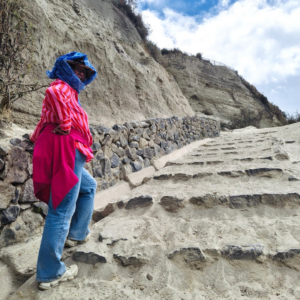
We walk the last 1.8 kilometers up the steps together. The view is beautiful, but the steps are tough. Every few steps you pant like a horse, and you notice that taking a deep breath is difficult. Your physical heart is really working super hard. I do understand why the population here is no longer growing. It is not at all convenient for the environment in which they live, work, and reside. I also understand the development of a broader chest well.
We have visited various parts of the Andes Mountains. Saw and met wonderful people. Beautiful nature, and every region just a little different. It feels like we have seen the tip of the mountain, literally snow-capped peaks.






Reply