When I started writing blogs and keeping up with Instagram, I wanted to share a true picture of our travel experiences—the things that really affect me, whether positively or negatively. I want to present an honest view. This story is about the less pleasant side of Peru.
As beautiful as the buildings and locations we visit are, the impression we get of some of the local people is just as ugly. I struggle to describe this respectfully when it feels like the people themselves have no respect for you. I’m sharing my experience with you, unfiltered.
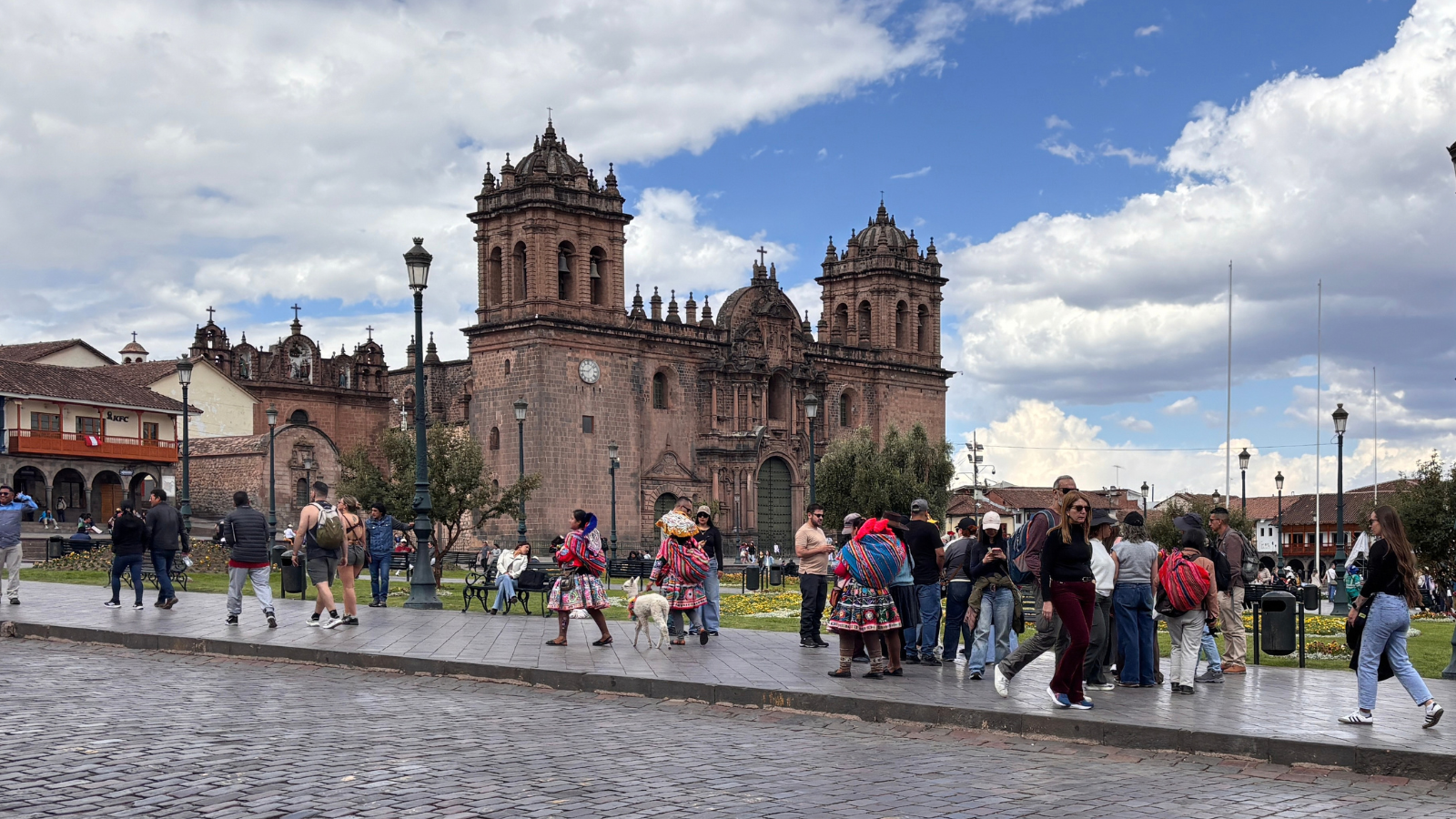
While sitting on a bench in the middle of Cusco’s stunning Plaza de Armas, you have to fend off twenty people in the span of five minutes who are trying to sell you things. Vendors glare at you if you turn them down—even when we’re just quietly waiting because we’re a bit early to meet our guide. At first, you politely say “no, thank you” every time. But after two days, you adopt the same negative, impersonal attitude as the vendors themselves.

An organized group is waiting here and gets swarmed by pushy vendors.
We visit beautiful historical sites rich in Inca history. We’re on an organized tour, which includes scheduled restroom breaks. Busloads of tourists arrive at the same spots for these stops. We’ve seen so many amazing things, but this aspect is a huge letdown. You have to pay to use the toilet, and you’re handed toilet paper at the door—fair enough. But at four different stops, there wasn’t a single toilet seat to be found. At two of those locations, the toilets wouldn’t even flush. There was filth and trash all over the floors. Can you imagine what it’s like, being just one person in a long line of many? One tourist politely informed the guide that a toilet wasn’t flushing. “Hurry up, we’re moving on,” was his response—treating her like a toddler. I was amazed by the guide’s arrogance throughout the entire tour. The restrooms at every historical attraction were absolutely disgusting. I can hardly believe it. Gross!!
Tip: don’t use the restrooms at historical sites; stop at a restaurant instead, and ALWAYS carry toilet paper with you.
Arjan and I are watching a parade on a street in Cusco. It’s amazing to see. During the parade, three different women pinned something onto me—completely unsolicited. They wanted money, and when I declined, they would furiously snatch the item back, nearly ruining my clothes in the process. I’m not usually fussy about my personal space, but having things pinned on me without asking while my attention is elsewhere—and then having the person get angry—wow!
I don’t want to complain in this blog, but I’ll describe a few more incidents.
Arjan and I were doing separate things for a while and had agreed to meet up at a specific spot in Cusco. I arrived early and sat down to wait. While waiting, I was pestered by roaming street vendors at least twice a minute. And honestly, most of them came back to me two or three times. One man was particularly pushy, literally thrusting a sweater into my hands. Once again, there was no respect for my “No gracias” or my personal space—as if my initial “No gracias” hadn’t been clear enough. Extremely pushy.
The same goes for women in beautiful traditional clothing who walk around with a small alpaca on a leash and carry lambs in their arms or bags. They literally thrust the lamb into your hands—”picture, please?”—and it happens constantly, everywhere. As you leave a restaurant or just turn a street corner; it makes no difference where. I am very interested in the beautiful clothing they wear, but I refuse to participate in the exploitation of animals. I would happily give them money if I could spend ten minutes talking to them about their home region and their traditional attire, but that opportunity simply isn’t there. So, every polite “no, thank you” is met with dirty looks.


And to top it all off, a few final observations. During our organized tour, we are served a buffet lunch. It’s included in the price and well-organized. We enjoy live music from a musician playing various flutes. Arjan has a bit of a sore throat. Hot drinks are included with the buffet, so Arjan happily opts for herbal tea. I order a large glass of fruit juice. It’s very expensive, but fair enough—we don’t mind supporting the venue. Arjan is asked three times if he wants a cold drink—which costs extra. How hard is it to see that he’s drinking tea and has already politely declined cold drinks for this lunch? Anyway. Lunch ends. The bill arrives—just for my drink. Proportionally, we’re paying three times what we’re used to in Peru for this juice. She asks for a tip; we thank her but don’t leave one—and then… the friendly waitress does a complete 180 and gets furious with us. It’s unbelievable. Earlier, the musician had come by trying to sell his music; we didn’t buy any, but we wanted to support his livelihood, so we gave him some money anyway. He gave us a beautiful smile. Yet, the final impression we take away from this lovely restaurant is the angry glare from the waitress standing by the exit. It feels incredibly disrespectful.
Tourism is very important in Peru. The country boasts magnificent historical sites, and its food and drink have a rich history. We are genuinely impressed by the country. Of course, there are nice people, too. But dealing with pushy vendors, angry glares, and filthy toilets every day really dampens the experience. It casts a gloomy shadow over our stay here—and we are only halfway through our trip to Peru.
Reply