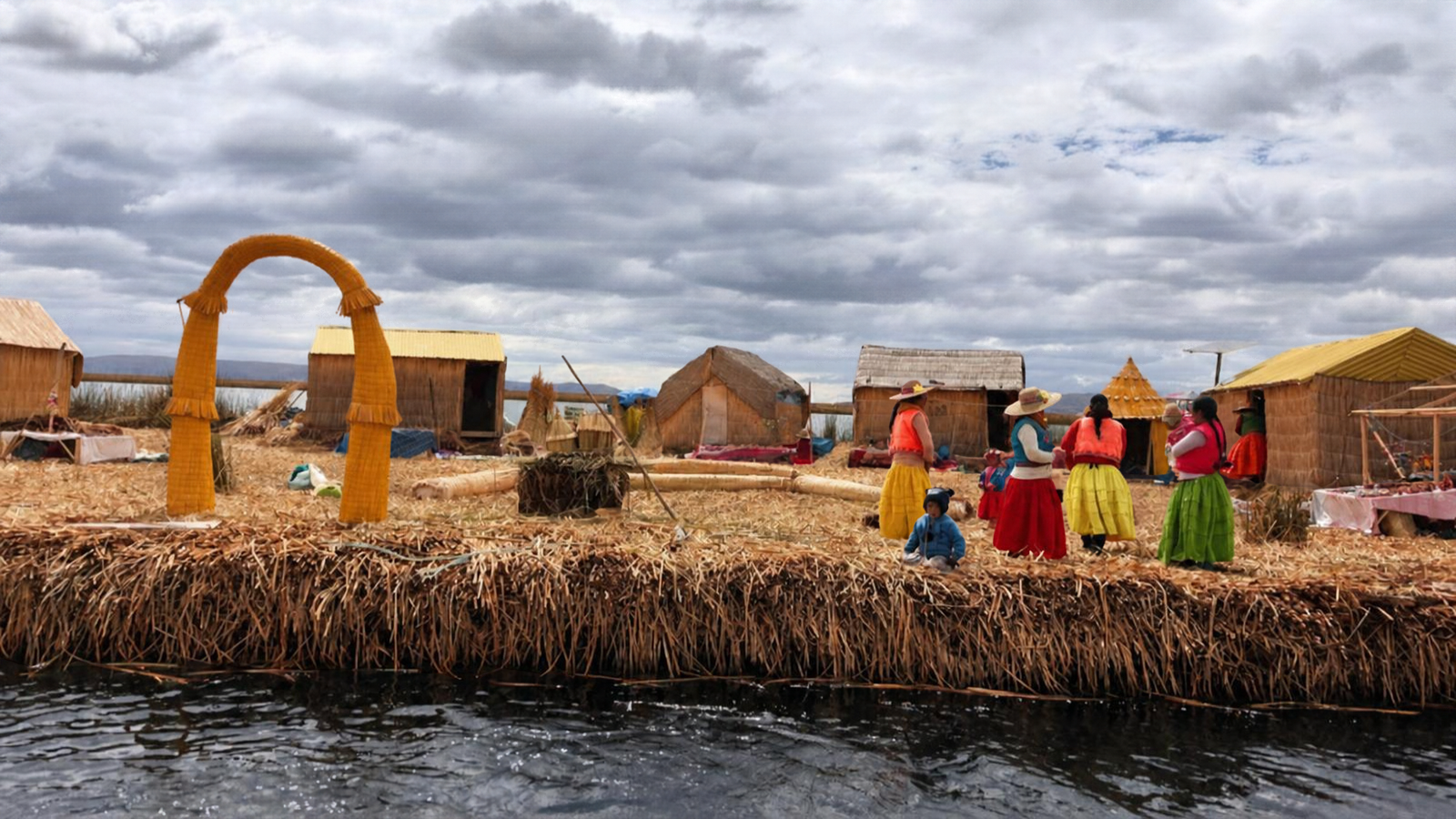
Our final days in Peru take us from Cusco to Puno via the Hop Peru bus, where we head out onto Lake Titicaca. Years ago, we watched a documentary about people living on reed islands on a vast lake; today, we are here to visit the Uros islands on Lake Titicaca ourselves. We had been warned beforehand that the islands exist primarily due to tourism and small-scale fishing. The people originally took to the water out of poverty, seeking to avoid paying property taxes.
Maintaining a reed island requires a great deal of labor. The base is constructed from matted, rooted reeds, and an island lasts about 25 years on average. Depending on the weather, a fresh layer of reeds must be laid over the entire island every two weeks. Six families live on the island we visit, and there are many small children. We learn that life on the islands is physically demanding and that many people suffer from rheumatism caused by the constant dampness and cold from the water. Additionally, many islanders suffer from parasites because the lake’s water quality is deteriorating; all of Puno’s sewage drains into Lake Titicaca, and the Uros islands are located just half an hour from the city. Our guide tells us that while 4,000 people once lived on the reed islands, only about 1,000 remain today. Children who attend school on the mainland invariably choose not to return to the arduous life on the reed islands once they reach adulthood. Consequently, within a few years, the Uros islands will likely be reduced to just a handful of tourist-oriented sites. It is entirely understandable that the children choose a different life.
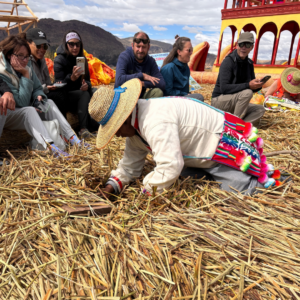
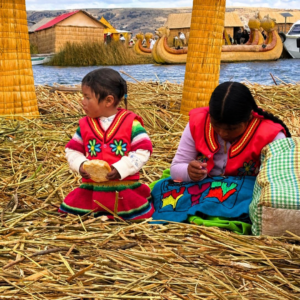
We see nothing but tourists visiting the various islands all around us. The islanders charge high prices for their handicrafts and for a short trip in the ‘traditional’ reed boat. On one hand, you feel like you’re being fleeced as a tourist, yet at the same time, the poverty of their homes is striking; these people are truly struggling to make ends meet. It leaves us with mixed feelings. It is different from what we saw in the documentary a few years ago, and I wonder what it will look like next year. It feels a bit like we’ve been gawking at a dying breed—a very conflicting sensation. We are struck by the hardship of their lives, but also by the way they try to squeeze money out of us. Arjan always feels very uncomfortable in highly touristy areas, while I am amazed by the harshness of life and the limited resources on the islands. Long after our visit, we still find ourselves talking about life on the Uros islands.
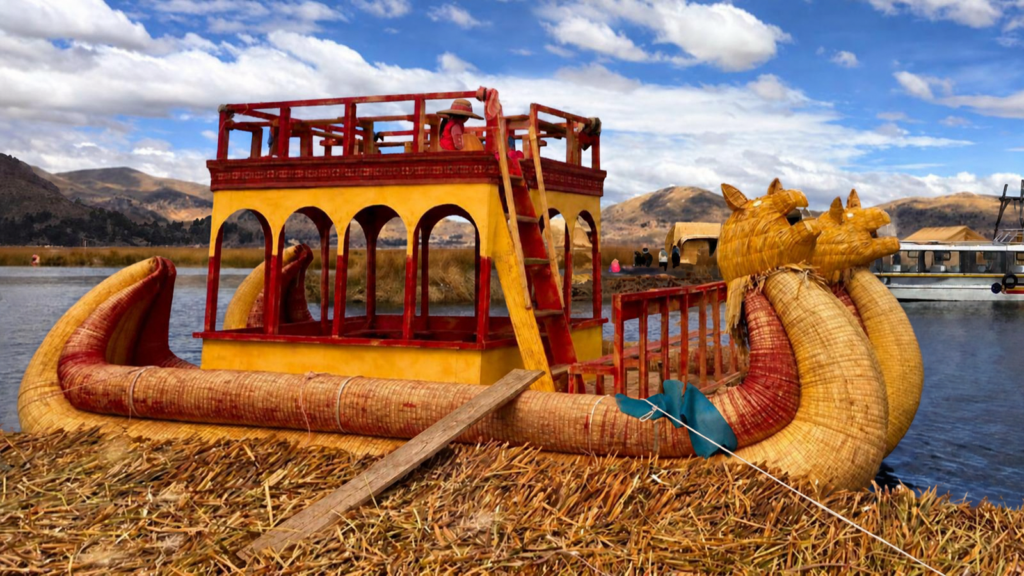
The boat—originally made of reeds—is actually largely plastic, disguised with reed and wooden paneling. It is towed by a small motorboat; we are herded onto it in large numbers and have to pay a hefty price. It is optional, yet practically unavoidable. The downside of tourism.
From the Uros Islands, we sail on to Amantani Island, located further out on the lake. We spend the night there with local residents—a homestay. Amantani’s bay sits at an altitude of 3,800 meters, while the island’s temples are at 4,100 meters. We booked this trip just this morning, so we are letting the day unfold as it comes. Upon arrival at Amantani, we are welcomed by the locals and served lunch: quinoa soup and a homemade roll with strawberry jam. You seem to get nothing but strawberry jam everywhere in Peru. It’s quite peculiar.

The island covers an area of approximately 9.8 square kilometers and has 4,000 inhabitants. We’ve picked a bad day for it: it’s windy and cloudy, rain is on the way, and the feels-like temperature is 3 degrees. We haven’t experienced such cold weather yet on our trip. Fortunately, there are thick wool blankets on the bed, so the only thing that will get cold is our noses.
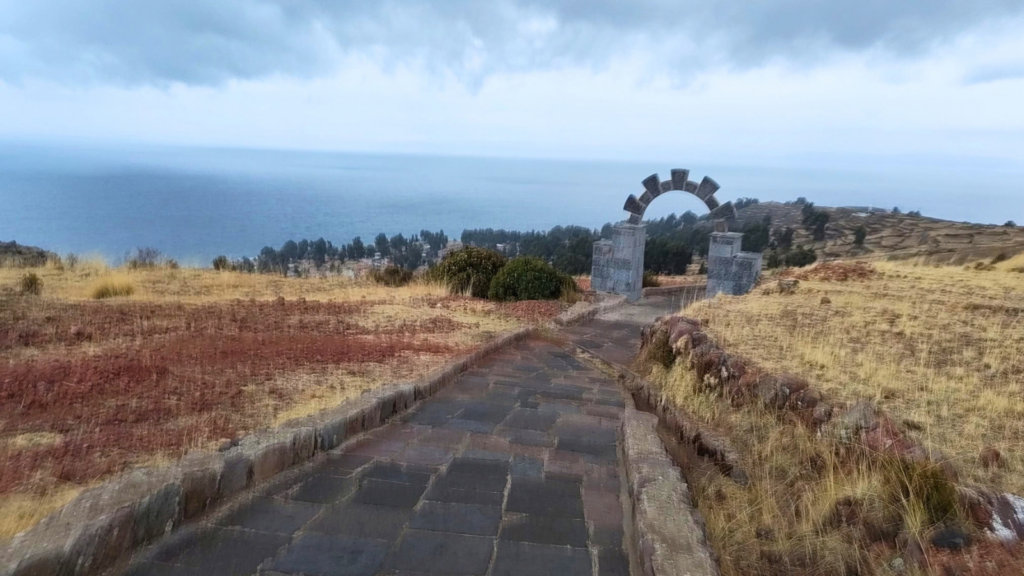
The island has two temples on the two sacred mountains Pachamama and Pachatata, both of which are pre-Inca culture. Pachamama is mother earth, connected to fertility, agriculture and the earth. Pachatata is Father Earth, the male counterpart of Pachamama, connected to the cosmos and protection. The Spaniards have also been here and so there is also a Catholic church. And in the middle of the square is a statue of the first Inca emperor Manco Cápac.
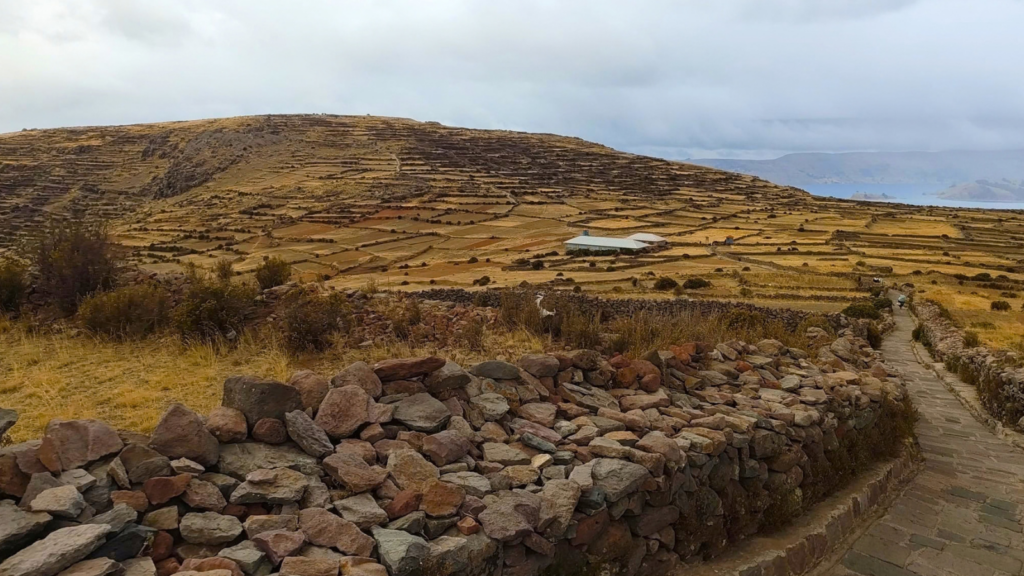
What’s great is that the island observes both Catholic and pre-Inca traditions. January 15th is the feast day of Saint Sebastian. On Amantani, they celebrate the *Fiesta de San Sebastián* (also known as *Pachatata* and *Pachamama*) on the third Thursday of January; during this festival, they visit the sacred mountain and make offerings to Pachamama for fertility, rain, health, and a good harvest. One religion doesn’t have to exclude the other. I love that.
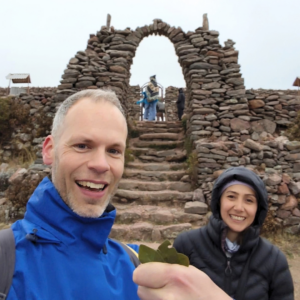
Arjan walks with Julietta to Pachatata to ask for a blessing in the temple using coca leaves. You walk the path backwards three times and then tuck a leaf somewhere into the temple wall. You repeat this three times, after which you entrust your wish to Pachatata.
What makes the island special is how people live and work together. There is no police force on the island. A mayor is elected every four years. There are ten communities, and within each community, a leader is chosen annually. These leaders can be men or women; in the community where we are staying tonight, the leader is currently a woman. The island feels balanced—in harmony with nature, within the community, and between men and women. They value certain principles, such as “one day I do something for you, and the next day you do something for me.” The island functions as one large community, and decisions are made collectively.
Each community has its own traditional attire. For women, this consists of a white blouse with beautiful appliqué work and a black cloth featuring highly colorful appliqué designs. All women on Amantani wear the same sandals, a skirt, and a sash around the skirt. However, the color of the overskirt varies by community; we see women wearing bright red, orange, green, and blue, while our hostess wears purple. To Arjan, this feels almost communist, as it leaves little room for individuality. I view it as a simplification of life: no one is superior or inferior to another, yet there is still room for individual touches—such as in hairstyles. The woman wearing the black skirt and black top is the elected representative for this year. After this year, she will continue to wear the jacket, but the black skirt will revert to being a purple one. The men wear suits, and if they have served as representatives, they carry a colored bag containing coca leaves. When they meet, they do not shake hands but instead share coca leaves, taking them from their own bags and placing them directly into the other person’s bag; there is no physical contact during this exchange.
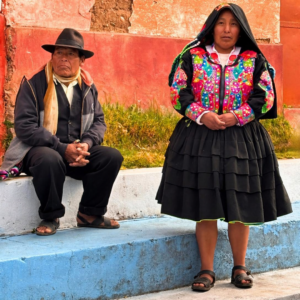
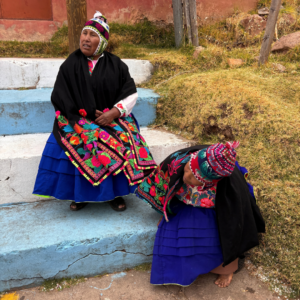
The entire island is virtually vegetarian; meat is eaten only on holidays. In our local host’s garden, quinoa grows like a weed, alongside plenty of kiwicha and amaranth. Kiwicha is packed with calcium, and back in the Netherlands, we recognize both of these as superfoods. For dinner, we are served potatoes and a root vegetable that falls somewhere between a carrot and a potato—similar to the white root we know as yuca. Life on the island is simple; everyone works the land and grows their own food, even into old age. We briefly wonder if this is a “Blue Zone” island, given how long the residents live. Sheep roam everywhere here; the locals harvest their wool and sell the meat to the mainland.
Now we just have to hope the cloud cover breaks around 9:00 PM so we can see the Milky Way—we are at such a high altitude, after all. Unfortunately, it remains wet and cold. Today, we fully appreciate the need for hats with earflaps. We’ve seen children coming home from school wearing alpaca sweaters and hats, and the local women wear them too in this cold wind.
We are staying with a Colombian woman named Julietta at our hostess’s home. Our hostess is 52, divorced, and has adult children—but she is a real sourpuss. She is neither friendly nor hospitable; we really drew the short straw with her. She barely speaks to us, insisting that Julietta translate everything into broken English. We’ve picked up quite a bit of Spanish during our travels and understand a lot; we might need a moment to find the right words, but she ignores us completely. Julietta’s coat is completely soaked, and she is shivering with cold in just a T-shirt while sitting in the small kitchen for dinner. She had just shown us a bag full of ponchos, scarves, gloves, and hats intended for sale, yet she herself is wearing several cardigans layered on top of one another. So, I suggest Julietta ask for a blanket or a cardigan. The answer is a flat “No!” There are four other tourists we know who are being hosted by a different family; fortunately, we hear the next day that they had a pleasant experience. The tourists rotate among the local families. Our hostess last hosted tourists three months ago. It is a mentally challenging situation: lying in the cold and damp at high altitude in a bare room, with a makeshift outdoor toilet, and lacking both a towel and any sense of hospitality. It really affects you, and we are both very glad that we are only staying for one night.
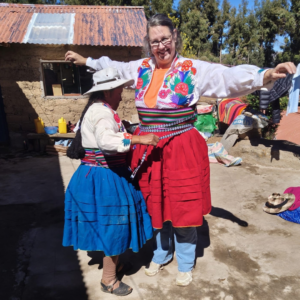
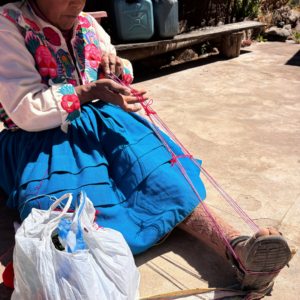
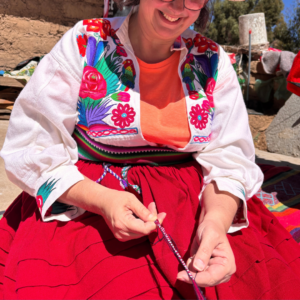
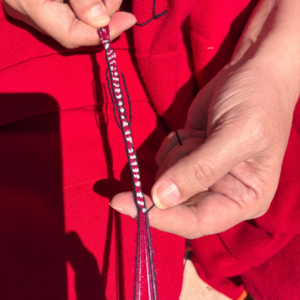
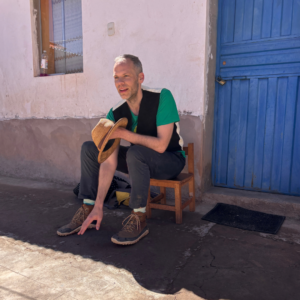

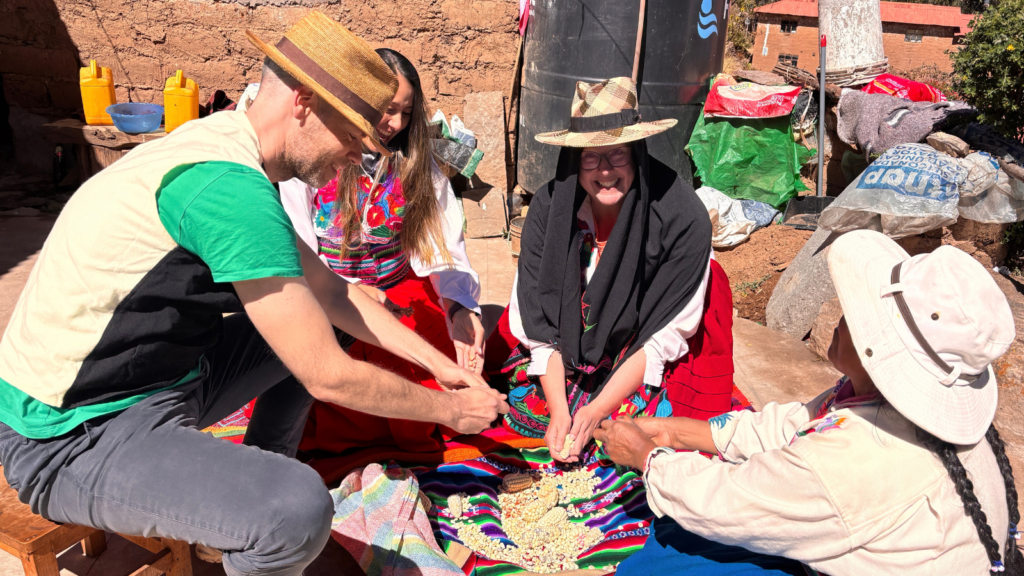
The next day is sunny, allowing all the wet items to dry out. This island operates on a system of reciprocity, so today we have to get to work. Dressed in traditional attire, we start by harvesting corn cobs. Afterward, we have to plow a patch of land, followed by a textile activity: hand-weaving. The weaving is exclusively for the women; I make a small bracelet that I get to keep. It is fascinating to see and learn this technique. Arjan does physical work in the fields, but afterwards, he faces another mental challenge to process. As a man, he is offered a stool in the shade, while we women are expected to sit and work on a mat on the ground. I don’t mind this at all, but the man sitting in the shade feels quite uncomfortable.
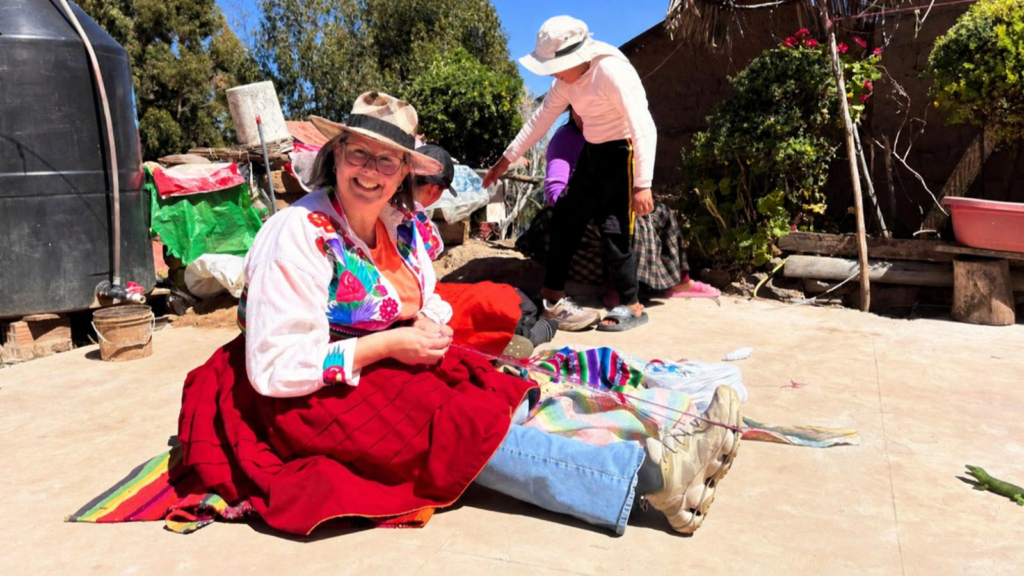
Once again today, we are being offered products for sale—items we have been seeing everywhere for weeks. The same mass-produced ponchos, scarves, hats, headbands, and gloves. Yet every region has its own traditional dress; men and women alike have hats specific to their area. The women wear garments featuring exquisite appliqué work and beautiful black shawls, which they customize with vibrant, colorful needlework patterns. But none of this is being highlighted here. A missed opportunity, if you ask me. I would love to see every region offer its own unique products—not factory-made goods, but items that extend the craftsmanship they already practice for their own communities. I hope that, in the coming years, there will be some development and education regarding the other values inherent in these communities. After all, that is so much more beautiful than a whole country filled with identical, mass-produced items. What I find sorely lacking here is an appreciation for their own creativity.

Reply