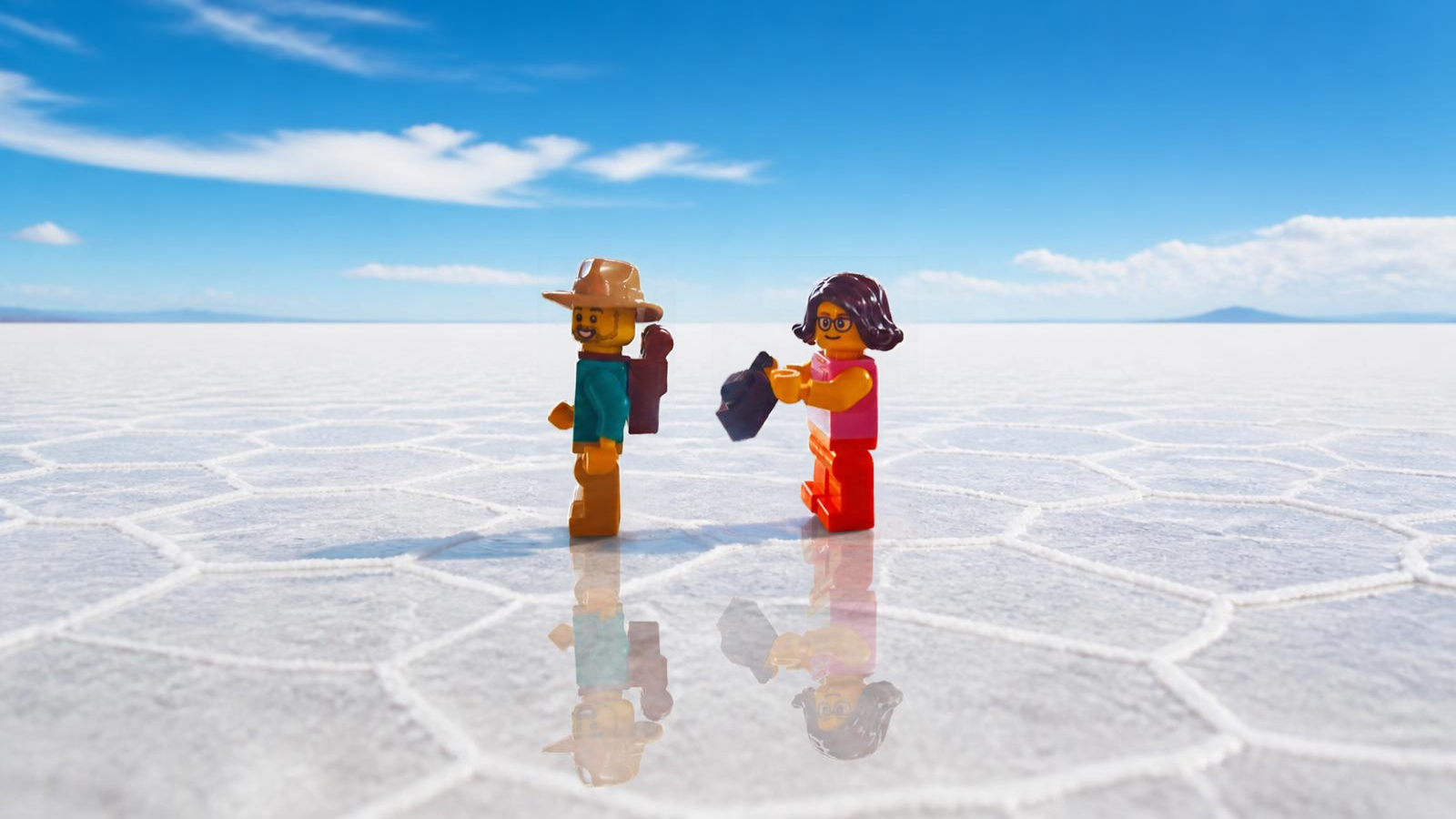
La Paz and Salar de Uyuni
Late in the evening, we take the Bolivia Hop bus from Copacabana to La Paz—the highest capital city in the world, situated at an altitude of 3,600 to 3,900 meters. It is dark, so we don’t see a great deal, though there is a tremendous amount of street life; there is a continuous line of stalls where you can grab a bite to eat. Just like in Peru, buying and eating meals on the street is common here. Poverty is immediately apparent, too; there are trash bags lying on the street and along the roadside, and I see people rummaging through them.
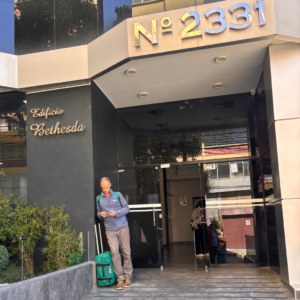
The next day, we both feel physically terrible. Judith has eaten something that didn’t agree with her, I have a headache, and we are both struggling to breathe. After asking our friend Chat a few questions, I realize we might be suffering from a delayed reaction to the altitude. We ascended too quickly—over a span of just two days—and slept at high altitudes in Puno and on Amantani. Our bodies don’t handle such a large jump in elevation—more than 500 meters—very well. After a few days, we start to feel a bit better; we extend our stay in La Paz by two days and plan the next leg of our trip. Off to Uyuni—the salt flats, red lakes with flamingos, and hot springs in the desert!
Then we discover that a nationwide strike is looming for September 28th. It is set to last at least a week and could turn rough. Tour operators in Uyuni give us conflicting answers regarding our three-day trip; there is a fuel shortage and uncertainty at the border due to the strike. We feel we have to make a choice: do we take a gamble and try it anyway, risking getting stranded in no-man’s-land at the Chilean border? Or do we quickly catch a flight to Santiago? We are both completely fed up with living at high altitude and have no desire to get stuck in the desert for over a week. So, we decide to fly to Santiago.
But, of course, we aren’t the only ones anticipating the trouble, and booking a flight proves difficult. Prices are skyrocketing, and we end up saving a lot of money by taking a massive detour. On the plus side, we get to tick Colombia off the list too! From Bolivia to Colombia with a stopover in Peru, then retracing our steps through Colombia before flying on to Chile. Just look at the map to see the detour we took!
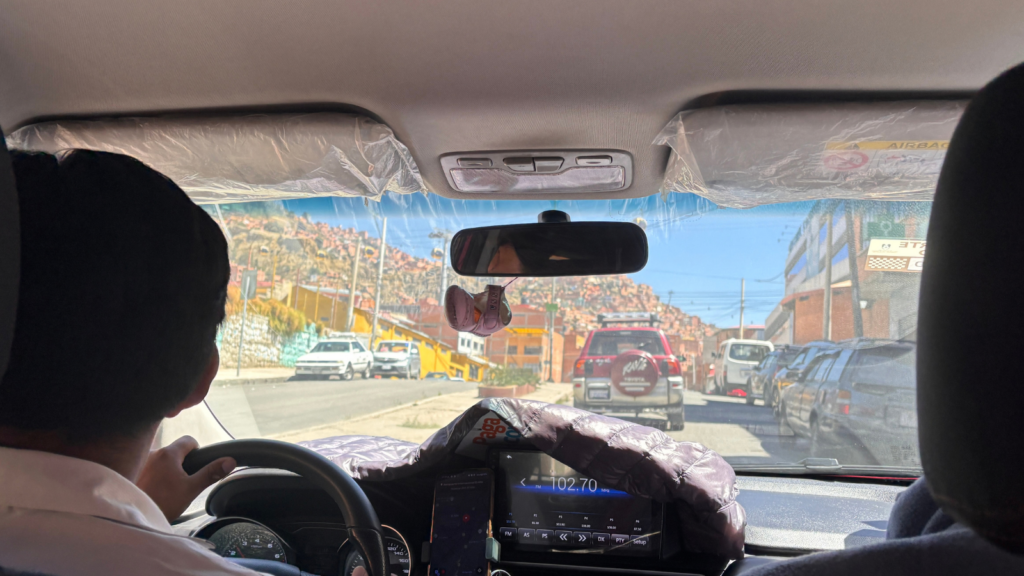
After checking out of our apartment in La Paz, we take an Uber, initially underestimating the sheer altitude the car has to climb. We marvel at the sight of La Paz spread out before us. Judith tries to snap a few photos, but we quickly realize that you really need to take the cable cars up to get truly great shots. It’s a shame we didn’t feel well enough during our stay in La Paz to explore the city properly. On the way up, we see the city from a different perspective. It is remarkably clean; we see hardly any litter throughout the ride—a stark contrast to how we arrived. And the houses are all fully finished, which is a huge contrast to Peru.
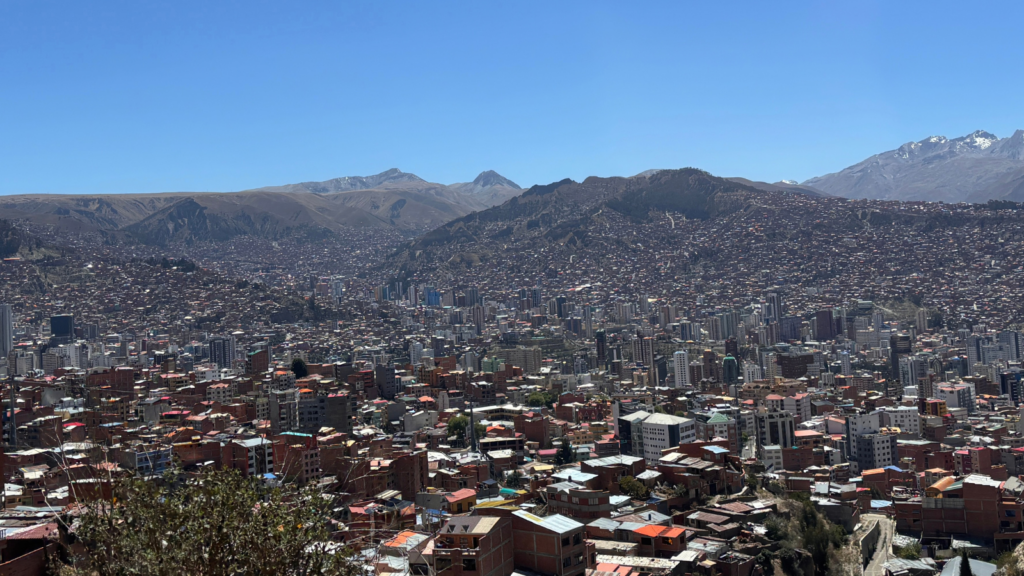
La Paz is a massive city nestled among the mountains. From our apartment in the lower part of the valley, we don’t realize just how densely built-up La Paz is—it’s quite a sight to see when driving to the airport.
We arrive at the airport with plenty of time to spare and play a game of *Clever*. After a cappuccino, we head towards customs. We discover just how easily narcotics can be smuggled out of the country. Before I can even position myself for the customs scan, the officer tells me—and Judith too—to just keep walking! We walk on. This is going remarkably easily. Ah, the next check: the narcotics screening area. Now we’re in for it—or are we? The bags have to go through an extra scan. That goes quickly and isn’t too bad, either. Right, boarding passes in hand—time to fly! But then, we’re caught off guard in the walkway leading to the plane. Everyone has to place their bags against the wall on the right, while we have to stand against the wall on the left. A few stern-looking men and a serious-looking dog are waiting for us. All the bags and passengers are sniffed by a real narcotics detection dog. It’s quite a sight! After the check, we’re all allowed to proceed onto the plane, and our bizarre journey is about to begin.
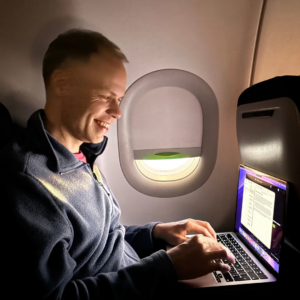
We fly from La Paz to Bogotá, and the plane is half empty. The weather is clear and sunny, allowing us to move from the left side of the plane to the right at the back and enjoy the magnificent mountain peaks. A little later, we spot Lake Titicaca; as we glance out the windows on the left, I quickly realize we are seeing Puno and the Uros Islands from above. We are flying low. It is a truly awesome hour—an unexpected tour for the day.
Salar de Uyuni will have to wait for another day; tip: This can also be done from San Pedro de Atacama in Chile. We had to skip that desert as well, so it remains on the list of places to visit.
Arjan
Reply